Two young kids work play with math tokens.

OSU faculty and students partner with Corvallis schools to make math fun

By Tom Henderson

Nathan Gibson was in fourth grade when he realized something shocking. Math is fun.

It happened when he started studying the oft-dreaded multiplication table. “I realized pretty quickly that you don't actually memorize it,” Gibson said. “There's a trick to it. You just count by seven or count by eight. That got me thinking of math as more of a game than a chore."

Gibson, the associate head of OSU’s Department of Mathematics, wants children everywhere to realize math is fun – with a little help from their friends.

He started forming “math circles” at Corvallis public schools in 2023. Groups of five to 15 students get together weekly after school to enjoy the company of numbers and each other. Mathematics faculty members and students help guide the groups.

The groups attract more than kids who are into math, Gibson said.

"Math circles are for kids who like math and for kids who want to like math, so it's possible that they just don't like the math they're doing in classes, and they'll enjoy this more,” he said.

Graduate student Sarah Alberson wishes there had been a math circle when she was a kid. “I loved doing math, and I would have loved to join a club where we work through problems together.”

Students tackle assorted math problems, but not exactly the way they’re tackled in traditional math classes. “The types of problems we do are more fun and more approachable than the types of problems they're forced to learn because that's just what their grade level says they're supposed to know,” Gibson said.

A woman and man talk to two students doing math.

Nathan Gibson and Abigail Adjei from Oregon State work with local Corvallis undergraduate students.

Math problems often depend on knowing the formulas or techniques from a previous math class. “The problems we look at have a lot more to do with logic or common sense or just sitting and thinking about it for a while -- puzzling it out,” Gibson said. “It's closer to Wordle than a traditional math problem."

The math circles began at Franklin School, a Corvallis school with kindergarten through eighth grade. After starting in the primary grades, the circles extended to the middle school level and have since spread to other local elementary and middle schools.

All but two Corvallis elementary schools now have math circles.

“The main benefit for students is that they get a chance to see mathematics that is typically not found in the standard school curriculum, and they get extra mental stimulation/exercise,” said graduate student Hsaing Thum.

“We also seek to build understanding of these concepts by getting the students to come up with and provide explanations for their answers,” he said. “These skills easily extend to other areas where they need to be clear with their thinking.”

The most important aspect of the circles is the camaraderie, Gibson said. The groups do more than solve problems together. They talk about how the problems have similarities and differences as well as the solutions.

"We try to dig a little deeper, get more abstract to give them a hint on how to approach the harder problems," he said. "This type of problem solving is just more fun in a group.”

Thum said he wants to share his excitement for mathematics. “Looking back, as a kid and teen I failed to appreciate many aspects of the math clubs I had while growing up,” he said.

Gibson said he never failed to appreciate his early math education. His fourth-grade teacher gave him extra worksheets so he could play with numbers while others labored over 9x7.

"From that time on, I knew I would be a math teacher,” said Gibson, adding he hopes that feeling is contagious.

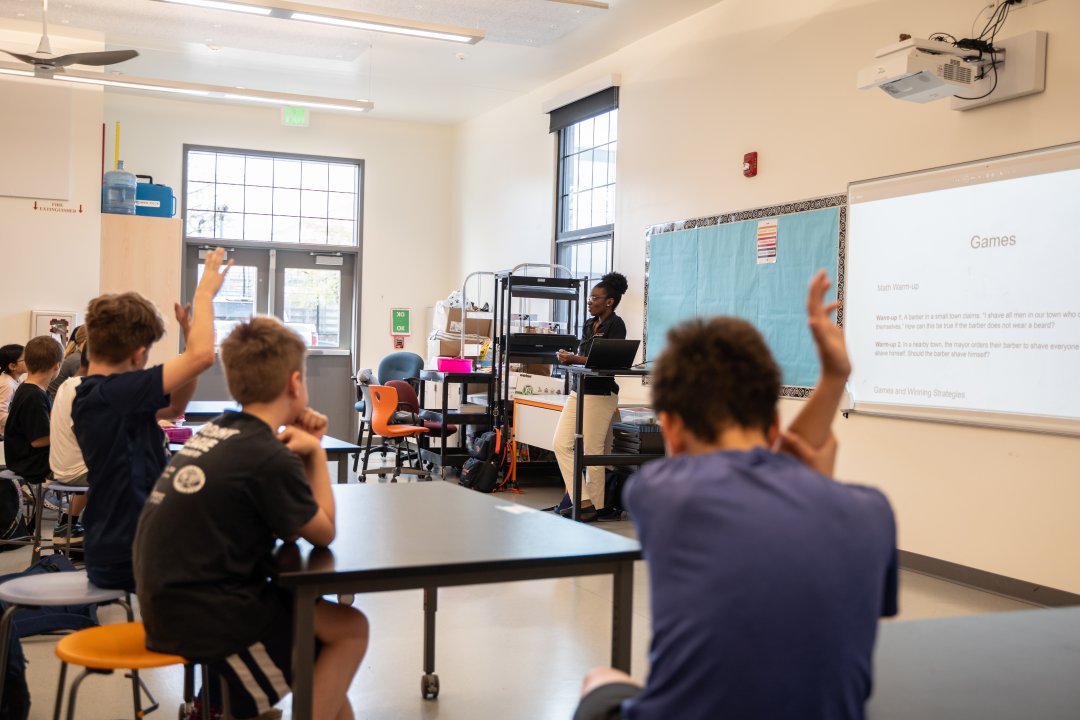
A woman teaches math to elementary students.

Abigail Adjei from Oregon State works with local Corvallis undergraduate students.


Read more stories about: faculty and staff, students, mathematics, outreach