Undergraduate Research

Where classroom learning comes to life

A student researcher looks at a vial of fruit flies with his smiling mentor

Biochemistry and Molecular Biology undergraduate Francisco Hernandez worked with mentor Alysia Vrailas-Mortimer on aging and age-related disease research, using the fruit fly model.

Opportunities in every department

Faculty in the College of Science are always on the lookout to help students develop their skills. Talk to your advisor or a faculty member working in the field you are interested in to get started on your research journey at Oregon State. Check out the department research sites below to learn about some of the research opportunities available in the College of Science:

Find more opportunities in the section below: Research Opportunities for Undergraduates

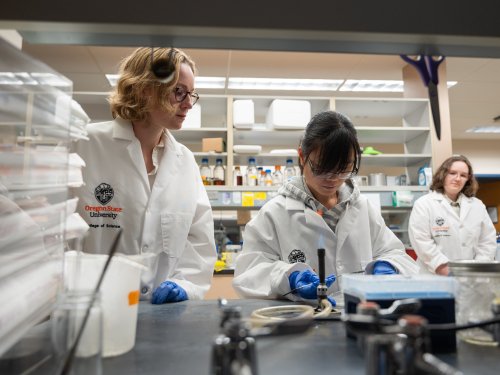
Biochemist Colin Johnson and his students developed a unique method to overcome major challenges in studying the otoferlin protein and its role in human deafness.

Undergraduate research at Oregon State

In the College of Science, you collaborate on undergraduate research that addresses real-world problems, preparing you for top graduate programs or training at globally recognized institutions.

Oregon State University, Oregon’s research and innovation powerhouse, provides exceptional opportunities for impactful research and real-world problem-solving. College of Science students benefit from this environment, affording them extensive opportunities for discovery and hands-on experience. OSU is the state’s largest public research university and one of only 40 nationwide to receive the Carnegie Foundation’s Tier 1 Very High Research Activity and Community Engagement designations.

Research takes many forms — whether in the lab, field, through modeling, surveys or data analysis, you'll gain valuable experience.

Why do undergraduate research?

  • Expand your mind and explore career options
  • Develop soft skills – critical thinking, analysis, teamwork and leadership
  • Develop hard skills applicable to your future STEM career
  • Apply classroom learning to real-life situations
  • Help create new knowledge and make an impact in the world
  • Build a professional network and connections in your field
  • Have fun!