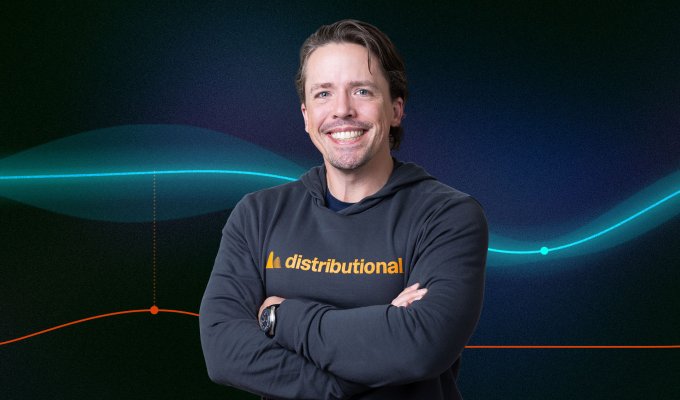
AI entrepreneur Scott Clark (‘08) makes the case for putting AI in research’s “mechanical middle,” with scientists at the frontier of discovery. On Monday, Oct. 5, Clark will return to the College of Science to share how that partnership could work.
MIT astrophysicist Sara Seager, a pioneer in exoplanet discovery and the search for life beyond Earth, will discuss how new discoveries are transforming scientists' understanding of where life may exist in the universe.
Join the Department of Microbiology as it hosts Vincent Racaniello, Higgins Professor of Microbiology and Immunology at Columbia University, for an upcoming lecture, "Pivoting from poliovirus to podcasts," as he shares his groundbreaking work in virology and how it led him to a dynamic science communication career.
The Department of Mathematics invites you to the 41st Lonseth Lecture on Thursday, May 28, with guest lecturer Laura P. Schaposnik. In her lecture, titled "Geometry of Hidden & Broken Symmetries," Schaposnik will break symmetry on purpose to see what drives reality.
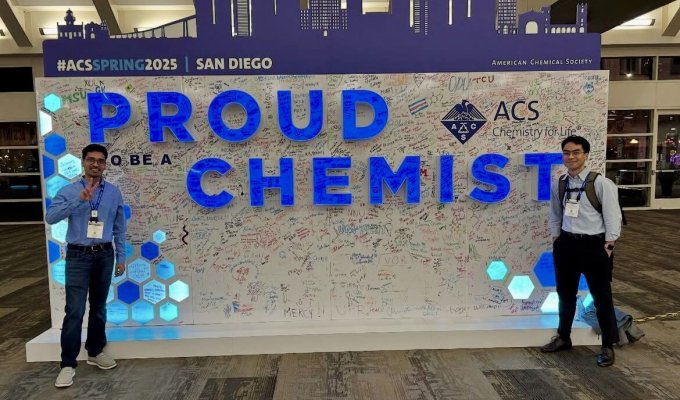
For graduate students in chemistry at Oregon State University, conference season is more than a professional milestone — it’s a launchpad for future careers. Each year, students share discoveries and gain experience presenting their work, but conference travel is costly, and not all research groups can fund the experience. This Dam Proud Day, we're rallying to offset these costs to ensure no budding scientist is kept from this important milestone.
At this year's Milne Lecture, Professor Bin Yu of UC Berkeley will introduce veridical data science: Grounded in three fundamental principles — Predictability, Computability and Stability (PCS) — veridical data science makes the uncertainties surrounding human decision-making in healthcare more explicit and assessable, aggregating reality-checked algorithms for better results.
Hannah Stuwe, a Ph.D. candidate in biochemistry and biophysics, will explore that question in the 2026 Inclusive Excellence Lecture, which will feature live music by local artists.
In the inaugural Val Nereo Lecture, presented by the Dept. of Statistics, UCSB professor Annie Qu discusses the challenges associated with multi-modal datasets, proposing a a novel Representation Retrieval (R2) framework.
On Thursday, January 15, the lecture, “A chemist’s journey: Unlocking new battery chemistries for a sustainable future,” will showcase his pioneering work developing safer, lower-cost, high-energy batteries by uncovering new chemistry principles. He will also share how he went from a small town in northeast China to Canada and then leading breakthroughs on a global scale.
Two College of Science faculty members — Maude David and Oksana Ostroverkhova — are helping bridge science and art in FutureFarmers: Silicon Forest, a thought-provoking new exhibition exploring the entangled relationship between ecology, technology and human agency.
Artificial intelligence is transforming the world—but how did we get here, and where are we going next? Join us to hear Rachel Ward, an applied mathematician known for her work on machine learning, optimization and signal processing from the University of Texas at Austin, share a talk titled, “From bits to bots: a mathematical perspective on generative AI.” Whether you're studying STEM, already immersed in the field, curious about AI, or passionate about the future of technology, this lecture offers a compelling look at the science and mathematical principles behind the algorithms—and the opportunities ahead.
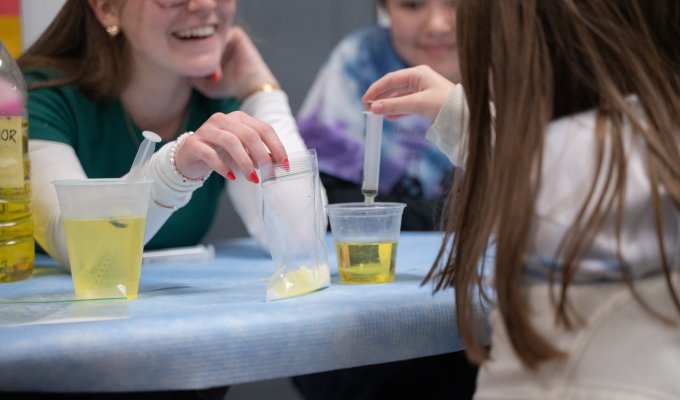
Since the early 2000s, Family Science and Engineering Nights have brought science and discovery to elementary schools across western Oregon. With bubbling beakers, cryogenic demonstrations and gooey gel beads, these interactive evenings make STEM come alive for countless families — thanks in large part to longtime co-organizer Margie Haak.