Research from the Department of Physics has shed new light on the way malignant cells change their shape and migration techniques to invade different types of tissue.
The College of Science welcomes Swati Patel and Axel Saenz Rodriguez who joined the Department of Mathematics as tenure-track assistant professors in September.
College of Science Research and Innovation Seed (SciRIS) awards fund projects based on collaborative research within the College of Science community and beyond.
The 2021-2024 Strategic Diversity Action Plan for the College of Science capitalizes on the core strengths of the College: An equity-minded community of students and scholars, a passion for scientific progress and a collective determination to defeat the barriers of inequality in science.
Oregon State University chemistry professor May Nyman has been selected as one of the leaders of a $24 million federal effort to develop technologies for combating climate change by extracting carbon from the air. The work by Nyman, OSU computational chemist Tim Zuehlsdorff and Argonne’s Ahmet Uysal and Michael Sinwell is part of a nine-project carbon capture and storage mission being funded by the U.S. Department of Energy.
University promotion and tenure criteria and processes should be broadened and made more inclusive to value innovation, entrepreneurship and other forms of scholarly impact, a collaboration led by Oregon State University asserts today in a paper published in Science.
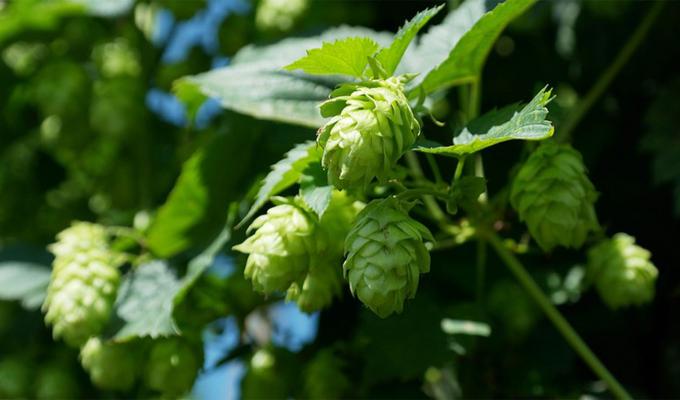
The health-enhancing performance of a compound found in hops is dependent upon its interactions with intestinal microorganisms, new research by Oregon State biochemist shows.
Led by Oregon State University researchers, more than three dozen scientists from around the globe have produced a guide to help nations better plan, evaluate and monitor marine protected areas set aside to safeguard ecosystems and support a healthy ocean.
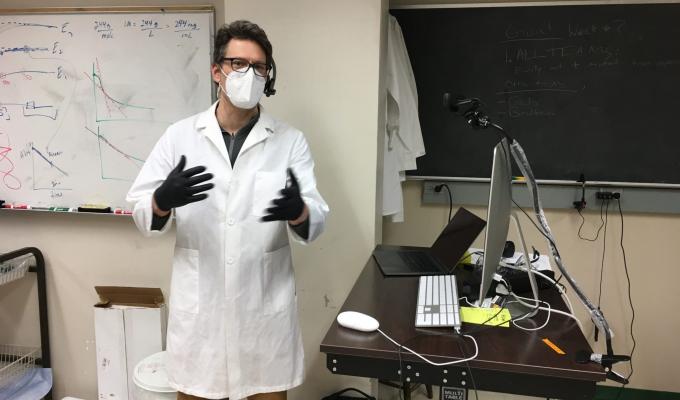
When the global pandemic forced the closure of college science departments across the nation, Dr. Kari van Zee, Dr. Ryan Mehl, Dr. Rick Cooley, and graduate student Phil Zhu—department faculty and research members at Oregon State University—had to think fast to adapt their hands-on senior-level research methods course to support remote and hybrid models of learning.
College of Science faculty were awarded $24.4 million in new research grants and awards in fiscal year 2021, a 55% increase over the average of the previous three years and one of the highest award levels ever.