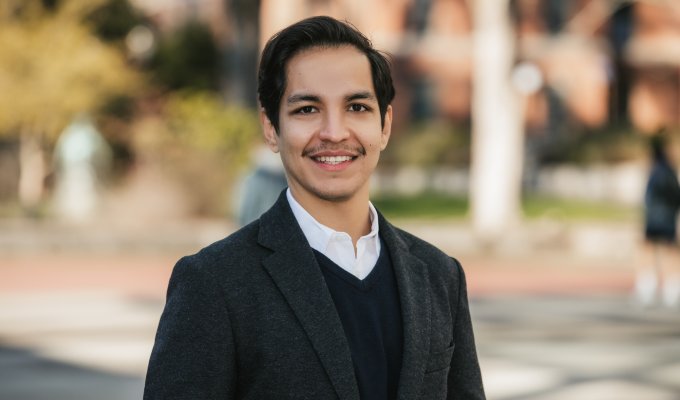
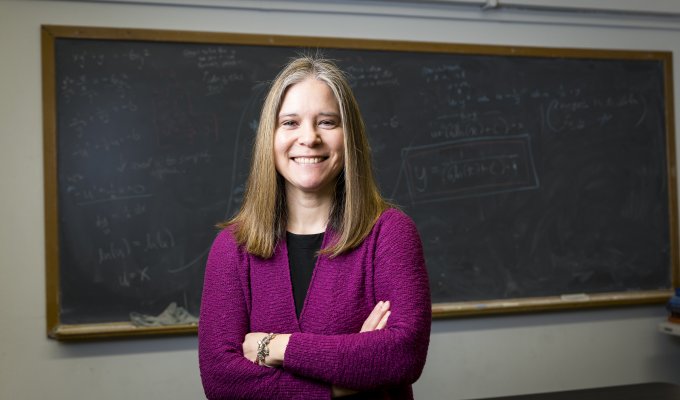
Light is more than just illumination – it’s the energy that makes life possible. Physical chemist Tim Zuehlsdorff is using his coveted National Science Foundation Faculty Early Career Development (CAREER) award to study what happens when molecules interact with light in dynamic environments, such as solvents or proteins.
Founded in 2018, SciRIS funds interdisciplinary research projects that aim to create meaningful societal impact. This year, biologist David Lytle’s project focuses on understanding the complex interactions between multiple biotic components, including food base, disease landscape and microbiome in the lower Colorado River, including the Grand Canyon.
The College of Science gathered on Feb. 26 to recognize and celebrate our high achieving faculty and staff at the 2025 Combined Awards Ceremony. The evening celebrated the very best in the College, from teaching, advising and research to inclusive excellence, administration and service. The following faculty and staff received awards in research.
The College of Science gathered on Feb. 26 to recognize and celebrate our high achieving faculty and staff at the 2025 Combined Awards Ceremony. The evening celebrated the very best in the College, from teaching, advising and research to inclusive excellence, administration and service. The following faculty and staff received awards in Inclusive Excellence, Administration, Service and Performance. Congratulations to all the awardees!
The College of Science gathered on Feb. 26 to recognize and celebrate our high achieving faculty and staff at the 2025 Combined Awards Ceremony. The evening celebrated the very best in the College, from teaching, advising and research to inclusive excellence, administration and service. The following faculty and staff received awards in the categories of teaching and advising. Congratulations to all the awardees!
Join us for the 2025 F.A. Gilfillan Memorial Lecture, featuring Dr. Elisar Barbar, a pioneering researcher challenging traditional views of protein structure.
Axel Saenz Rodriguez, an assistant professor in the Department of Mathematics, has been awarded the prestigious Simons Foundation Pivot Fellowship for his groundbreaking work at the intersection of probability theory and mathematical physics.
Elise Lockwood, a professor in the Department of Mathematics in the College of Science, has been honored with the Presidential Early Career Award for Scientists and Engineers (PECASE), the highest honor bestowed by the U.S. government to outstanding early-career scientists and engineers.
Taught by biochemistry and biophysics professor Phil McFadden, the Honors colloquium course Protein Portraits offers a uniquely artistic perspective on biomolecules.
A multidisciplinary research group is combining expertise in robotics, artificial intelligence, computer science, statistics and crop science to create a modern solution for an outdated system.
Xavier Siemens, a renowned astrophysicist and professor at Oregon State’s College of Science, has been awarded the prestigious 2025 Bruno Rossi Prize, one of the highest international honors in high-energy astrophysics, for his groundbreaking work uncovering evidence of binary supermassive black holes.
Oregon is becoming warmer and more prone to drought and will see less snow due to climate change, but people and businesses are also adapting to the challenges of a warming planet, the latest Oregon Climate Assessment indicates.