Physicist Oksana Ostroverkhova is studying organic semiconductors in her laboratory at Oregon State, exploring how light interacts with these materials and how those interactions can be harnessed to create new optoelectronic and photonic devices.
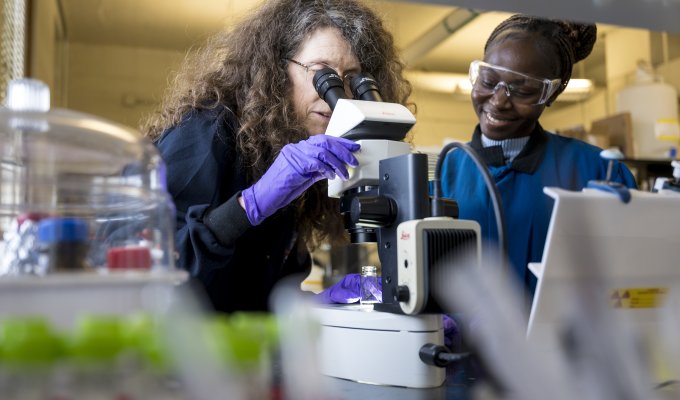
In the College of Science, materials scientist May Nyman and doctoral student Esther Julius are designing molecules that could help push the limits of traditional semiconductor manufacturing.
Both of the 2026 publications involve fluorescent proteins and their “core” chromophores that were first discovered in marine organisms such as jellyfish and coral. The earlier work focused on novel red-emitting graphene-sheet-based carbon dots engineered by the Cheng lab at College of Engineering.
Microbiologist Stephen Giovannoni received a 5-year $1.2 million award to continue studying the microbiology of the Sargasso Sea, an ocean gyre that is representative of ocean regions with extremely low productivity that are expanding globally due to the warming of the ocean’s surface.
The researchers used a molecule measuring technique to observe in a laboratory setting how certain metals can promote the protein clumping that leads to the blocked neural pathways associated with Alzheimer’s.
This year’s research honorees are advancing knowledge at the frontiers of statistics, microbiome science and astrophysics, with discoveries that shape public health, global policy and our understanding of the universe. Their scholarship reflects both international impact and a deep commitment to mentoring, collaboration and research excellence at Oregon State.
A research team including members of the College of Science has discovered a previously unknown chemical mechanism that may explain why harmful algal blooms are so persistent in nutrient-polluted lakes and reservoirs.
On Thursday, January 15, the lecture, “A chemist’s journey: Unlocking new battery chemistries for a sustainable future,” will showcase his pioneering work developing safer, lower-cost, high-energy batteries by uncovering new chemistry principles. He will also share how he went from a small town in northeast China to Canada and then leading breakthroughs on a global scale.
Giulia Wood has been named one of 43 Marshall Scholars in 2026, a prestigious scholarship offered by the United Kingdom to a select group of Americans to study at graduate level in a UK institution of their choice for up to three years.