Researchers in the College of Science have demonstrated the potential of an inexpensive nanomaterial to scrub carbon dioxide from industrial emissions. The findings, published in Cell Reports Physical Science, are important because improved carbon capture methods are key to addressing climate change, said Oregon State's Kyriakos Stylianou, who led the study.
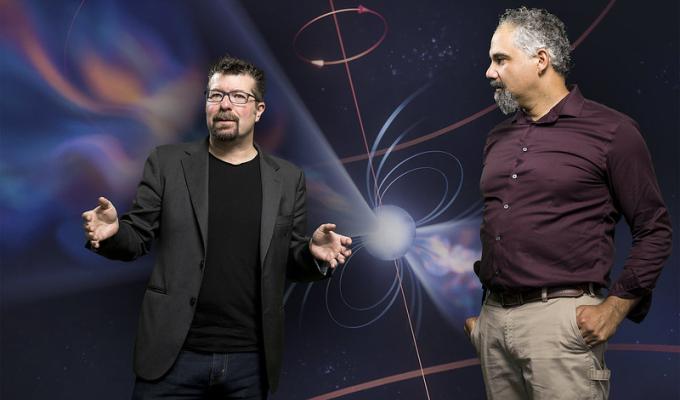
The detection of gravitational waves opens a whole new window onto supermassive black holes – a vitally important step in advancing human knowledge and helping to unlock the mysteries of how structures are formed in the cosmos.
How does DNA move? How do cells communicate with each other? When it comes to these questions, it’s easy to think of molecular biologists behind the words. But as physics and mathematics senior Sullivan “Sully” Bailey-Darland knows, there are many more voices asking.
A six-month study of healthy older men led by the College of Science’s Tory Hagen and research associate Alexander Michels demonstrated that daily multivitamin/multimineral supplementation had a positive effect on key nutrition biomarkers.
Goldwater scholar and graduating senior Alyssa Pratt has always had a love for the sciences. She started with a love for the stars and now spends her day in the cyberspace realm with her double major in computer science; and biochemistry and molecular biology at Oregon State University.
Being a Beaver has stretched Ebunoluwa Morakinyo to develop her passions inside and outside of the lab. A senior honors biochemistry and molecular biology student at Oregon State, her time on campus has included celebrating her culture while looking forward to a career dedicated to helping others.
Even though 1+2 will always be equal to 3, Madison Collins strives to teach math differently so that students can learn better and discover something new along the way.
Graduating high school at 16 is no easy feat. For Jessica Etter, it also meant the additional challenge of starting college at 17. Etter started her journey as an Oregon State University chemistry student with the goal of becoming a forensic scientist, however, she has since found a passion for research and will be starting a Ph.D. at Oregon State this fall.
Many people grow up with a fear of bugs, and above all else, a fear of spiders. Oregon State biology senior Catherine Raffin was just the same. The sight of eight spindly legs and a pair of fangs made her skin crawl, so she did the only logical thing: purchased a pet tarantula. “From a young age I was always morbidly fascinated with the insects everybody fears,” she said. “I thought it was crazy how something so small can be so terrifying.”
Lice: creepy, crawly, but to a young Amelia Noall, fascinating. “There was an outbreak at my school, and of course I got it. But I started looking at the bugs through my microscope and thinking, ‘Wow, these are so interesting!’” she recalled. As she followed her curiosity, picking leaves from the ground and examining their hidden structures through the microscope lens, she unknowingly paved the way toward her time as a microbiology major — and now senior — at Oregon State.
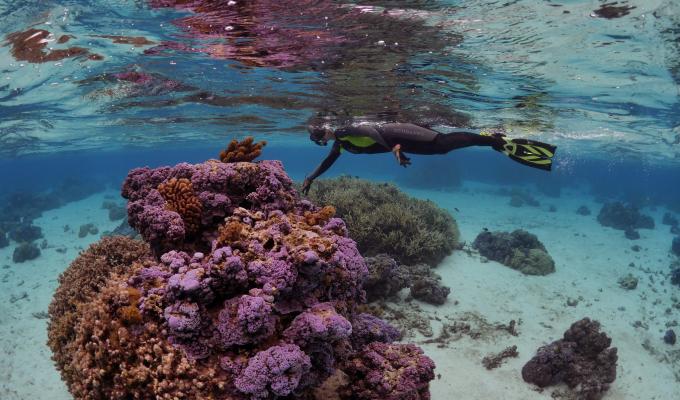
Microscopic algae that corals need for survival harbor a common and possibly disease-causing virus in their genetic material, an international collaboration spearheaded by an Oregon State University researcher has found.
Oregon State University Professor May Nyman received the prestigious F. Albert Cotton Award in Synthetic Inorganic Chemistry from the American Chemical Society.