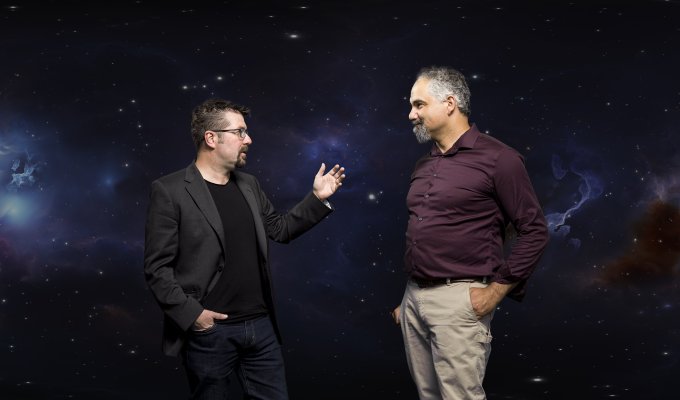
Two College of Science physics faculty members were instrumental in a groundbreaking study honored by IOP Publishing as one of 2024’s most-cited articles in astronomy. Xavier
Although time is an enemy for some, Janet Tate used it to leave a lasting mark on physics curriculum, students, and the field of thin-film semiconductors, earning her the 2024 Lifetime Achievement in Science Award from the College of Science.
Algal physiologist James Fox is a co-investigator on a $1 million study examining the impact of adding seaweed to the diets of beef cattle as a way to reduce greenhouse gas emissions.
An international collaboration that includes a College of Science astrophysicist has identified a phenomenon, likened to the quick-footed movements of an iconic cartoon predator, that proves a 19-year-old theory regarding how solar flares are created.
As the world held its breath, Oregon State alumnus Steve Bjornson waited for results. The VP and COO of Pfizer’s vaccine research and development organization, he successfully led a team of hundreds of scientists in an unprecedented effort to develop a COVID-19 vaccine.
The College of Science is proud to announce that Xavier Siemens, a distinguished astrophysicist and renowned leader in the field of gravitational wave research, has been elected a 2024 Fellow of the American Physical Society.
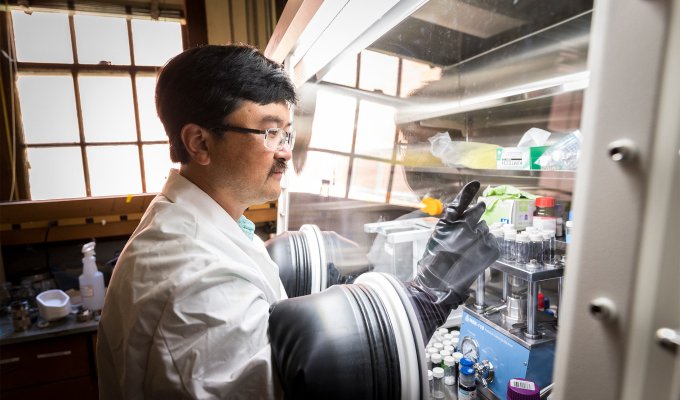
In the pursuit of large-scale, reliable, safe, environmentally sustainable and affordable electricity storage, chemist Xiulei “David” Ji is part of a collaborative, interdisciplinary team funded by the U.S. Department of Energy.
Faculty, staff and graduate students from the College of Science won nine awards at University Day, the celebratory kickoff to the academic year featuring an annual awards ceremony. These awards highlight excellence in teaching, advising, research and diversity advocacy, showing the College as a leader across the university.
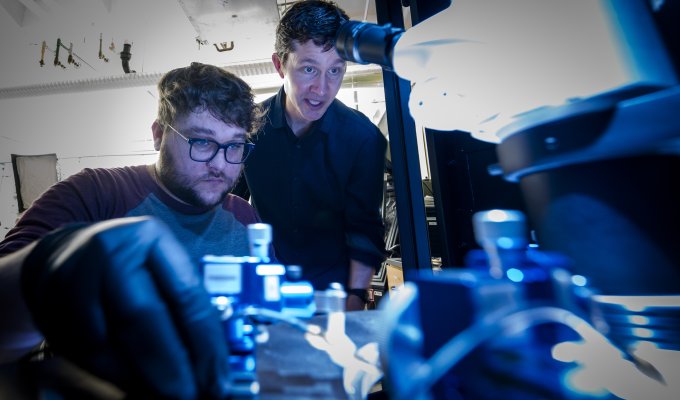
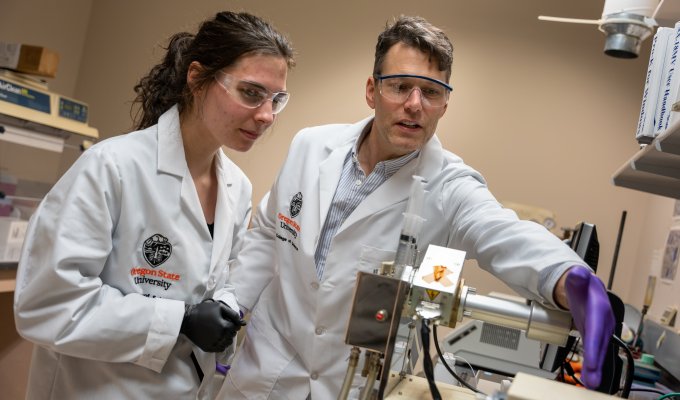
Physicist Ethan Minot and his laboratory are unlocking the potential of quantum materials to revolutionize technology. Their groundbreaking research is not only pushing the boundaries of science but also paving the way for student careers in the tech industry.
Researchers from the College of Science, including graduate students, have developed a material that shows a remarkable ability to convert sunlight and water into clean energy.
For billions of years, all life on Earth, from tadpoles to humans, have relied on the same 20 amino acids to build proteins — the fundamental building blocks of life. But what if that list of fundamental amino acids was expanded to include any chemical ability of our choosing? What new potential could be unlocked?