Oregon State University Distinguished Professor and Milton Harris Professor of Materials Science, Mas Subramanian, has been elected a fellow of the Neutron Scattering Society of America for “his insightful application of neutron scattering to provide far-reaching insights into materials chemistry.”
Collaborative science has the power to change the world. The 2024 College of Science Research and Innovation Seed (SciRIS) award recipients aim to use that power to develop better treatments for cancer and unlock the mysteries of complex mathematical equations.
Like many college students, Lexie Swisher confronted a difficult choice concerning her time: find a job on campus to afford rent or participate in undergraduate research. Thanks to an unwavering commitment made by college leadership and generous donors, Swisher secured financial support from Launching Undergraduate Research Experiences, or LURE, a groundbreaking program that pays students while they gain invaluable research experiences during the academic year.
Three years after the release of “Dune,” a film adaptation of Frank Herbert’s epic 1965 sci-fi novel, “Dune: Part Two” is reigniting the public’s fascination with sandy environs and humanity’s efforts to reshape them.
Sally Hacker, a professor of integrative biology in the College of Science, is working with the Oregon departments of Parks and Recreation and Land Conservation and Development to create guidebooks for coastal dune management based on the best available science.
A product used to control pest slugs on farms in multiple countries is deadly to least one type of native woodland snail endemic to the Pacific Northwest.
Professor and Department Head Dee Denver led a 10-week laboratory project that showed the effect of a biotool marketed as Nemaslug on the Pacific sideband snail. The study was published today in PLOS One.
Carley Beeman’s resume is impressive. Studying Honors chemistry with a focus on advanced biochemistry and a minor in biology, she has been a consistent figure on the Oregon State University Honor Roll. In January, she was announced the chemistry undergraduate of the quarter.
Scientists led by an Oregon State University chemistry researcher are closing in on a new tool for tackling the global problem of weedkiller-tainted groundwater.
Kyriakos Stylianou of the OSU College of Science led an international team that identified a material known as a metal-organic framework, or MOF, that showed an ability to completely remove, and also break down, the oft-used herbicide glyphosate.
In the intricate languages of mathematics and biology, alumna Rachel Sousa, ‘20, is multilingual. Since graduating from Oregon State, she has bridged the disciplines through several prestigious research experiences and credits her success to seizing opportunities no matter the odds.
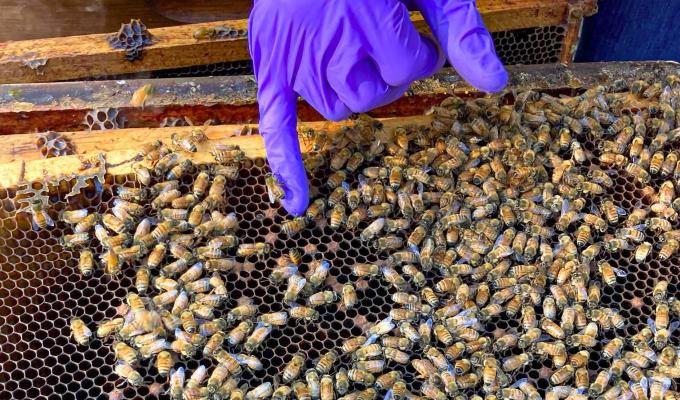
Although having a box of 300 buzzing bees in the corner of her laboratory is uncharted territory for Maude David, who typically works with humans, she maintains a steadfast belief that science moves forward through interdisciplinary teams.
A chemical element so visually striking it was named for a goddess shows a “Goldilocks” level of reactivity – neither too much nor too little – that makes it a strong candidate as a carbon scrubbing tool.