Since 1973 the Survey Research Center has been working with Oregon State faculty and state government agencies to help them conduct and analyze surveys.
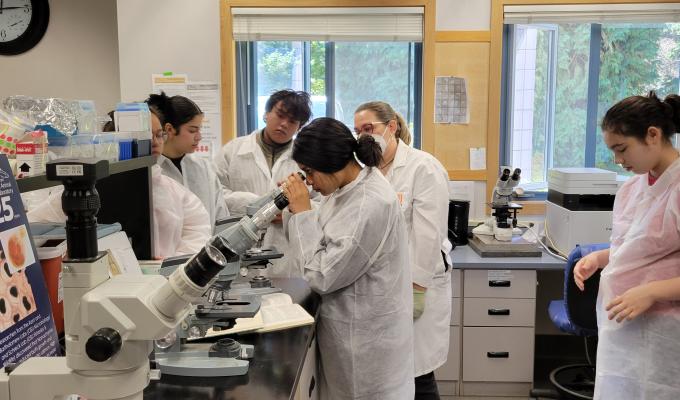
This past summer, Ph.D. student Savanah Leidholt set out to create a summer “bootcamp” for area high school students to draw more students from BIPOC, LGBTQ+, low-income and other diverse backgrounds to the study of microbiology.
Oregon State University Assistant Professor Swati Patel and two colleagues wanted to do something to counter systemic inequities in mathematics. In response, they founded the Math For All conference at Tulane University in New Orleans. Math For All is now a national conference that hosts regional conferences annually throughout the country, including a satellite location at Oregon State.
Rachel Palmer, the new assistant director of career development in the College of Science has always "hit the ground running" and has no intention of slowing down. In this new position, Palmer aims to educate students on the importance of career development.
Internationally acclaimed microbiologist Jo Handelsman, who served as the science advisor to U.S. President Barack Obama as the Associate Director for Science at the White House Office of Science and Technology Policy, will give the inaugural Berg Lecture on Thursday, April 27 at 5 p.m.
Larvae produced by black rockfish, a linchpin of the West Coast commercial fishing industry for the past eight decades, fared better during two recent years of unusually high ocean temperatures than had been feared, new research by Oregon State College of Science shows.
Scientists led by an Oregon State College of Science researcher have developed a new electrolyte that raises the efficiency of the zinc metal anode in zinc batteries to nearly 100%, a breakthrough on the way to an alternative to lithium-ion batteries for large-scale energy storage.
Four-dimensional tissue self-assembly, integrated river health and ultra-tiny spectrometers: The 2022 College of Science Research and Innovation Seed (SciRIS) award recipients will use collaboration to fill critical knowledge gaps across numerous scientific disciplines to drive real-world impact.
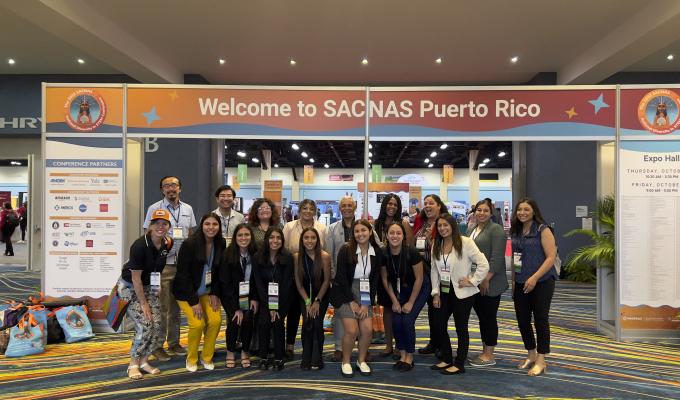
Students from Oregon State University along with thousands of other attendees from across the nation were welcomed to the National Diversity in STEM (NDiSTEM) Conference Oct. 27, 2022. The event was built to serve as a reminder that culture and science are not mutually exclusive or contradictory. NDiSTEM asserted that science is not a place to shed culture, but a place where it should thrive.