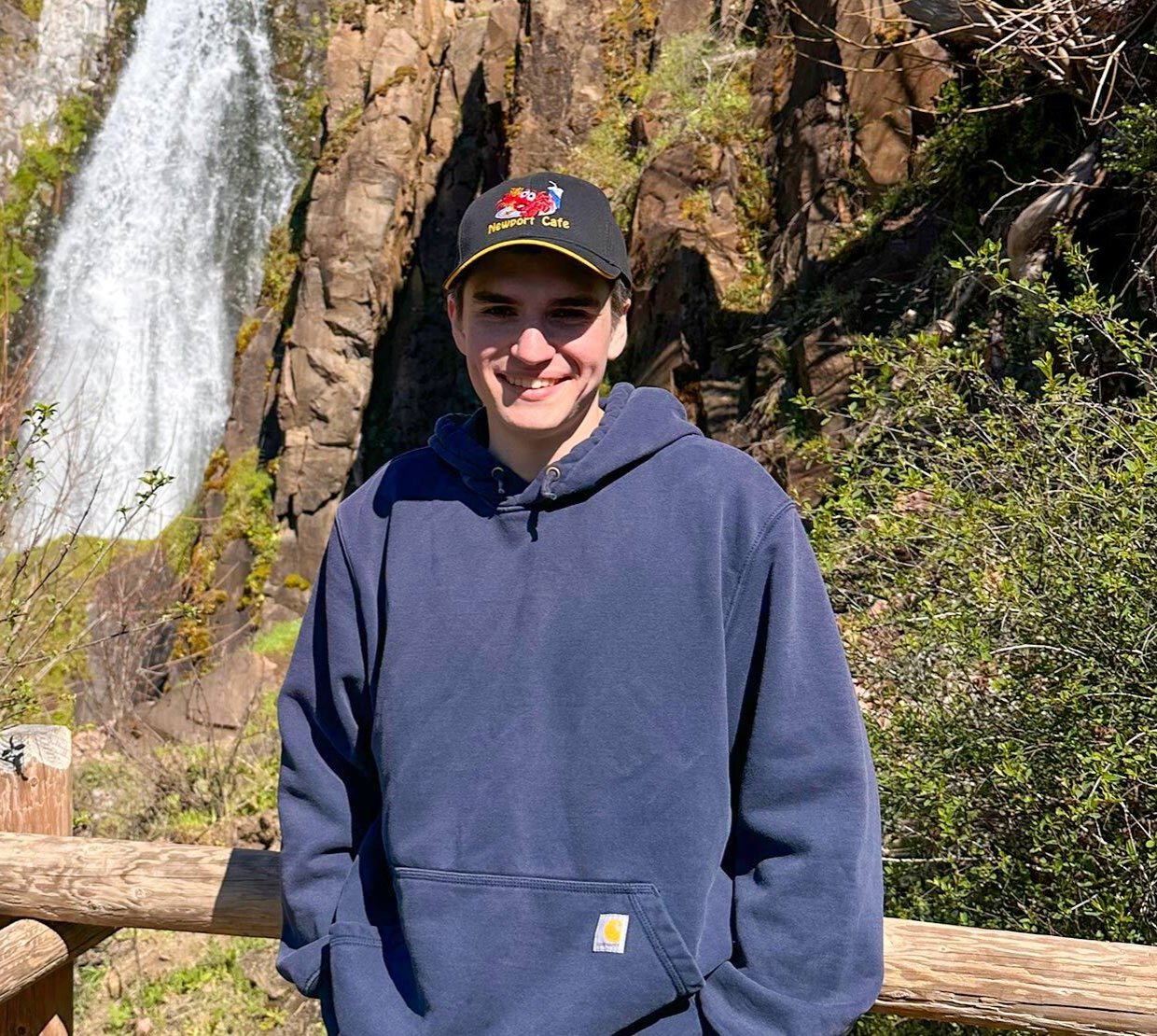
A man stands in front of a waterfall.

Biology senior earns Fulbright for Antarctic krill research

By Hannah Ashton

Antarctic krill may be small, on average less than 2.5 inches long, but they help sustain everything from penguins to blue whales. Through undergraduate research at Oregon State, biology senior Matoska Silva developed a fascination with the tiny crustaceans that has now earned him a Fulbright award, a highly competitive international exchange program that funds students to conduct research and teach abroad. Silva will travel to Chile to study ecological interactions involving predators and ocean processes that shape their distribution.

A big part of this project focuses on ecological interactions involving predators, in addition to the physical oceanography aspect.

Silva will spend nine months at the Austral University of Chile and collaborating with the Chilean Antarctic Institute, investigating how ocean currents influence the movement of krill and how their abundance overlaps with the foraging activity of predators such as penguins and seals. If weather goes according to plan, the beginning of his trip will include a research cruise to the South Shetland Islands. The project will combine ecological data, acoustic surveys and oceanographic modeling to better understand one of the Southern Ocean’s most important species.

The opportunity is the culmination of years of undergraduate research that began shortly after Silva arrived at Oregon State. Working in the laboratory of marine ecologist Kim Bernard, he gained experience studying zooplankton, acoustics and polar ecosystems while contributing to research projects in the Pacific and Arctic Oceans. Those experiences helped shape a Fulbright proposal that will allow him to expand his skills, build international collaborations and contribute to a growing body of research on the foundation of Antarctica’s food web.

“Every fact that we use about krill, somebody had to find,” Silva said. “Being part of that system is really rewarding. I like the idea of putting in work to figure something out that other people will then be able to use to figure other things out.”
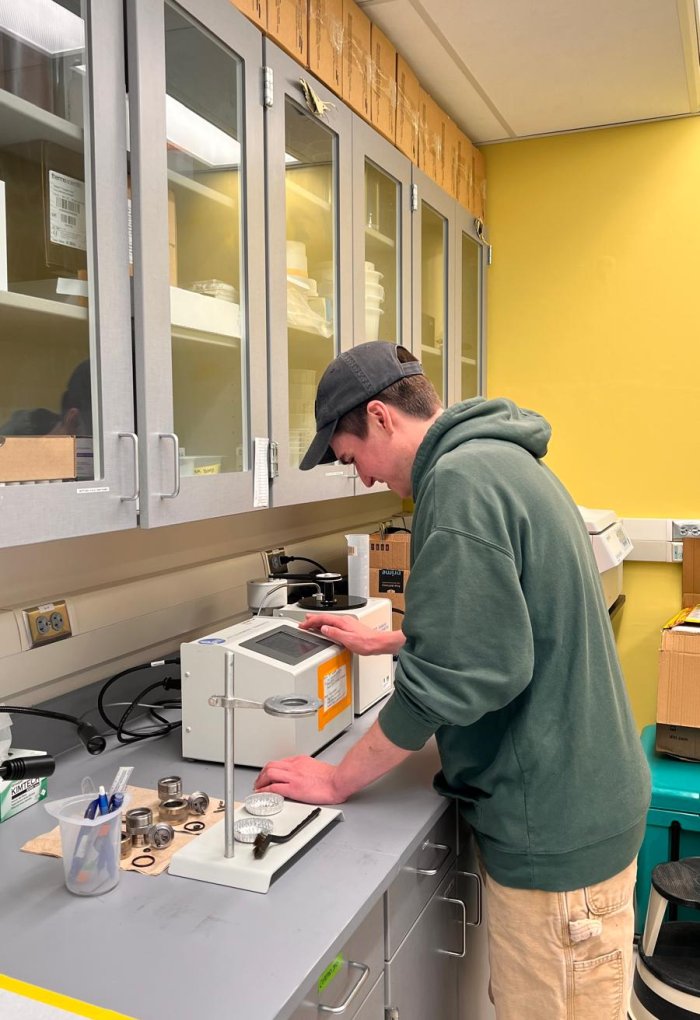
A man in a sweatshirt in a laboratory.

Silva operates a bomb calorimeter in the Krill Seeker Laboratory. Photo by Kim Bernard.

From early curiosity to Antarctic ecosystems

Silva traces his interest in science back to childhood experiences outdoors, where curiosity about small organisms and natural systems came from simple exploration, turning over rocks, digging in soil and observing the life around him at close range. That early hands-on curiosity gradually developed into a broader interest in how ecosystems function and how organisms interact within them.

When he arrived at Oregon State, Silva intended to study biology, though his early career ideas leaned more toward applied natural resource management. Research, especially polar ocean science, was not yet the clear direction it would later become.

His first lab experience came through a bioengineering project studying mouse brain tissue in a chronic pain model. The project involved attempting to quantify differences in hippocampus size between treatment groups and control, but methodological issues ultimately made the approach unworkable.

“I set out to try to quantify hippocampus size differences,” he said, “and then later figured out that the way that we were doing it was just never going to work.”

Still, he said the experience helped him understand something fundamental about scientific work early on: failure is often part of the process, especially when learning new techniques.

“That’s a good thing to figure out early on,” he said. “When you have a fatal flaw.”

Finding a path in marine ecology and krill research

After that first experience, Silva joined the NSF-funded Research Experience for Undergraduates program, which led him into the lab of marine ecologist Kim Bernard. That shift marked a turning point, moving him from biomedical research into ocean science and eventually toward polar ecosystems.

In Bernard’s lab, Silva worked on Pacific Ocean projects and gained experience with zooplankton ecology, acoustic data and large-scale environmental datasets. Over time, he became especially interested in krill and the role they play in marine food webs.

“I think where a lot of people start is at the charismatic megafauna level of whales, polar bears and all of that,” Silva said. “But a lot of where the magic happens is at the phytoplankton and zooplankton level, sort of the massively abundant species that provide the foundation.”

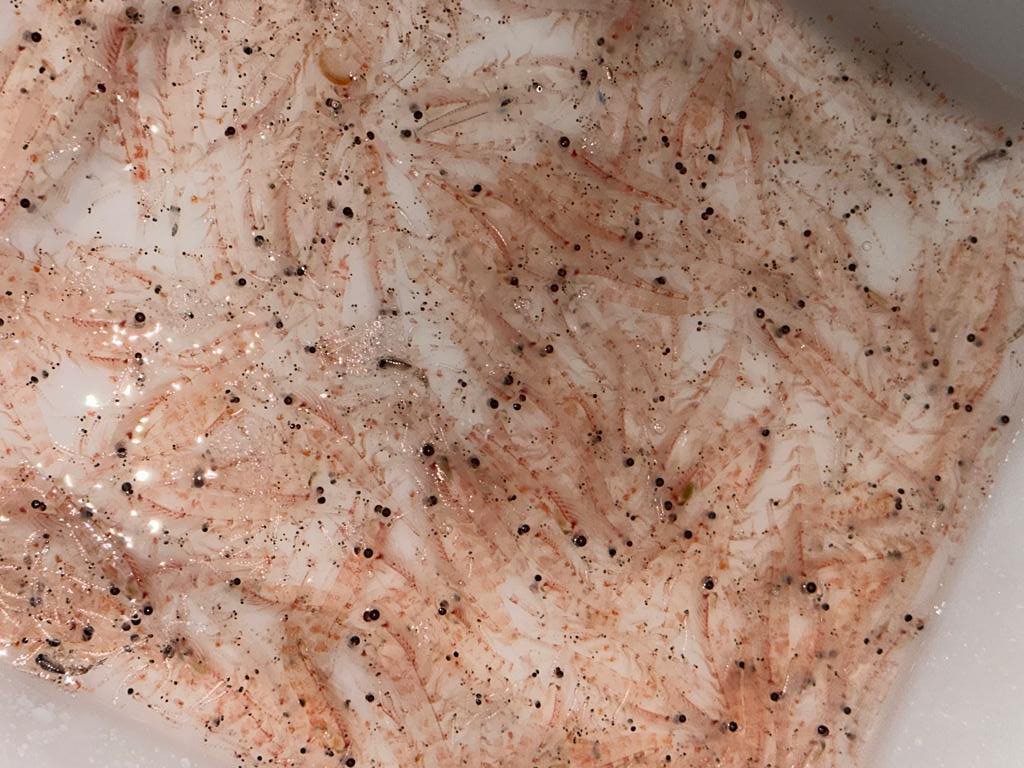
Krill.

Antarctic krill, the focus of the upcoming Fulbright project. Photo by Kim Bernard.

That shift in focus, from large, visible animals to the small organisms that sustain them, became central to his academic path. Krill, in particular, stood out in the Southern Ocean, shaping energy flow across entire ecosystems.

"Krill are fascinating because they are a massive contributor to feeding so many different species in the Antarctic ecosystem," he said, including whales that migrate long distances to feed in Antarctic waters.

Through his work, Silva also began to see science as a cumulative process built on countless incremental contributions.

“I like the idea of putting in work to figure out something that other people will then be able to use to figure other things out,” he said.

Beyond his laboratory research, Silva also gained experience presenting science to international audiences. With support from the College of Science Student Travel Award and the College of Earth, Ocean and Atmospheric Sciences Experiential Learning Fund, he traveled to Montreal in May to attend the ASLO-SIL Joint Meeting, an international conference focused on aquatic science. There, he presented research on Arctic zooplankton and connected with researchers from around the world.

“Even though it was just for a few days, I think this was a really good warmup experience for participating in science in other countries,” Silva said. “I also recommend other OSU students who are interested in international science to participate in an event like this.”

A man in a white lab coat poses for a selfie.

Silva poses with the ZooScan imaging system, used for his Arctic zooplankton research.

Fulbright research in Chile and what comes next

Through the Fulbright program, Silva will spend nine months working in southern Chile with collaborators at the Universidad Austral de Chile and the Chilean Antarctic Institute. His project will examine how ocean currents and physical processes influence krill distribution and how those patterns of krill abundance align with predator foraging behavior in the Southern Ocean.

He will analyze acoustic survey data collected over several years in the Nelson Strait region, along with GPS and dive data from tagged penguins and seals. He will also work with oceanographic models that simulate how currents transport particles to better understand how physical processes shape where they concentrate.

“It’s basically looking at where we are seeing a lot of spatial overlap between where predators are spending a lot of their time, and if that is where we’re also seeing high biomass of krill,” he said. “The ocean is so dynamic, that’s really hard to say before going in.”

The project will also require him to learn new physical oceanography methods, including Lagrangian simulations, and to adapt to working in Chile, where he will navigate both a new scientific environment and daily life in Spanish.

After the Fulbright, Silva plans to pursue graduate study in marine ecology or a related field, though he is still considering whether his long-term path will lead toward academia or government research. For now, he sees the experience as a way to deepen his technical skills and expand his understanding of polar ecosystems.

His perspective, shaped by years of undergraduate research, is rooted in the idea that science advances through collective effort rather than individual breakthroughs.

“It takes a slow process of working and learning and developing,” he said.

And while krill may be small, Silva’s work shows how much of the ocean depends on them, and how much scientific discovery depends on steady, incremental contributions built over time.