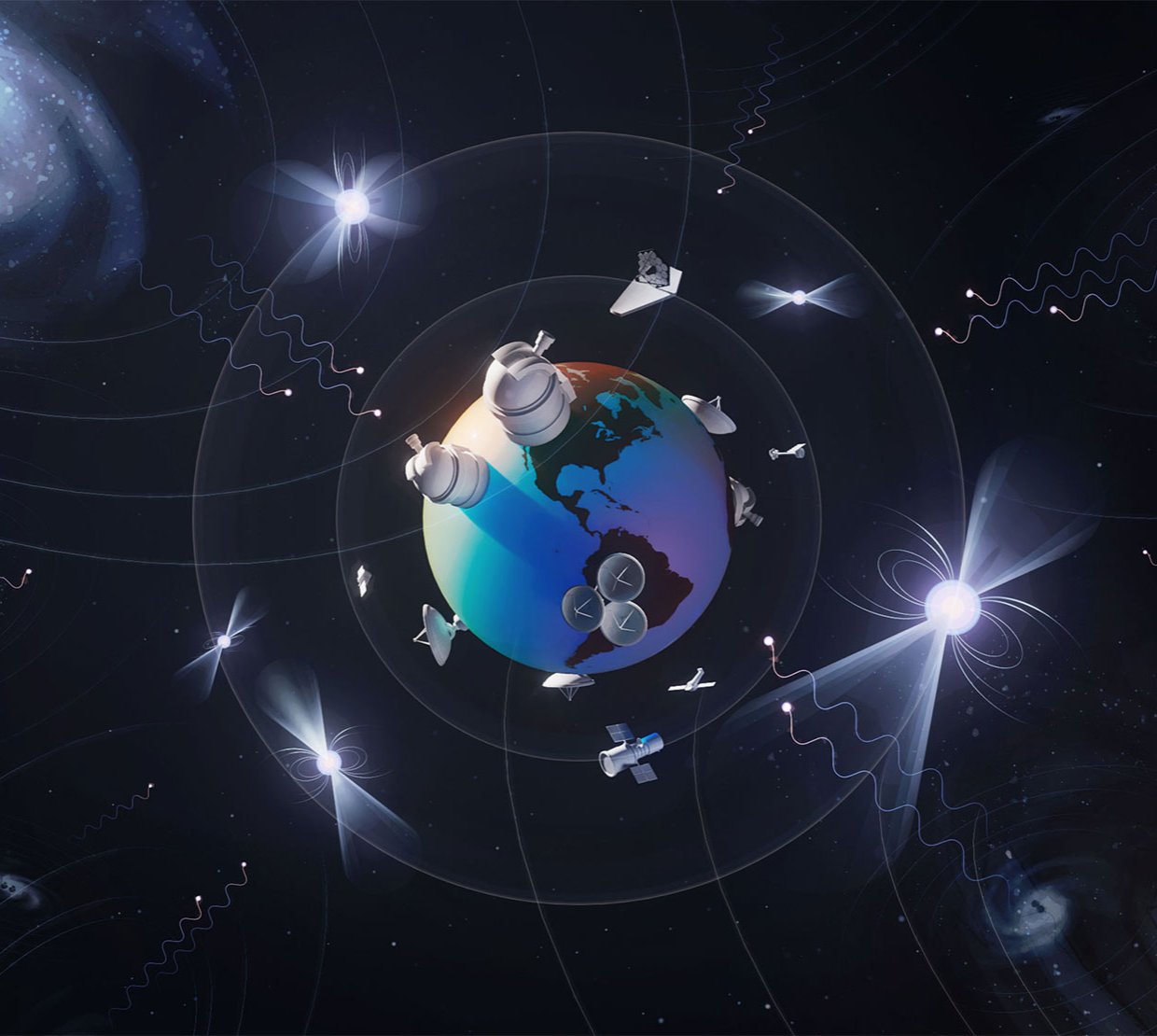
An illustration of cosmic objects and gravitational waves surrounding earth

College of Science AI Showcase: From classrooms to cosmos

By Hannah Ashton

For almost 20 years, physics center NANOGrav has been detecting and studying cosmic gravitational waves. Now, machine learning will help them analyze and understand exactly which phenomena are causing them. Illustration by Olena Shmahalo.

During Oregon State University's 2026 Artificial Intelligence Week, researchers from across the College of Science gathered to demonstrate how artificial intelligence is transforming scientific discovery. From predicting the behavior of complex physical systems to uncovering patterns hidden in biological data, faculty shared how AI is helping answer questions that were once beyond the reach of traditional methods.

This story is the second of a two-part recap highlighting the presentations.

Integrating Large Language Models into the Scientific Workflow: From prompt engineering to AI-Enabled Discovery

Tom Sharpton, professor of microbiology and statistics, is developing artificial intelligence tools that help researchers generate hypotheses, analyze data and synthesize scientific knowledge while maintaining rigor and reproducibility.

His lab focuses on adapting large language models (LLMs) for scientific research. These AI systems, trained on vast amounts of text, can synthesize literature, generate code and interact with users through natural language. Sharpton sees significant potential for the technology to accelerate discovery, but only when paired with careful oversight and validation.

A major focus on his work is creating frameworks and infrastructure that help scientists use LLMs responsibly. One project establishes guidelines for evaluating AI-generated outputs based on the level of risk involved. For example, a researcher may need only minimal verification when using AI to draft an email, while biological interpretations or analytical recommendations require extensive expert review.

To support researchers, Sharpton’s team has also designed an open-access library of structured prompts and best practices designed specifically for scientific applications. The resource helps users interact with LLMs in ways that reduce errors and improve the reliability of results.

The lab has also built a microbiome data analysis “co-pilot” that guides researchers through complex analytical workflows. The system relies on validated code from existing software repositories, explains the reasoning behind its recommendations and creates a transparent record of every decision, helping improve reproducibility and confidence in the results.

In collaboration with Google, Sharpton is also working with the Co-Scientist platform, an AI system designed to generate new hypotheses by identifying connections across scientific disciplines. His team developed tools that organize and prioritize the platform’s outputs, making it easier for researchers to identify the most promising ideas for further study.

Student-driven changes to computational problem-solving practices through generative AI

Patti Hamerski, assistant professor of physics, studies how students use generative artificial intelligence in STEM classrooms and how those tools are changing the learning process.

Her research focuses on computational physics courses, where students increasingly rely on AI tools to help debug code, solve problems and complete assignments. Rather than evaluating whether AI helps students reach the correct answer, Hamerski examines how these technologies influence the decisions students make along the way.

Through classroom observations, she found that generative AI can significantly alter the problem-solving process. In one example, a student used ChatGPT to diagnose an error in a coding assignment, copied AI-generated code into the program and encountered new errors before ultimately identifying the underlying problem himself. While the student arrived at the solution, the path he took differed substantially from traditional approaches to learning and troubleshooting.

Hamerski argues that these changes raise important questions about how students develop scientific reasoning and problem-solving skills. Her work examines learning not simply as an outcome, but as a process shaped by interactions among students, instructors and technologies. Because AI systems influence the choices students make, she views them as active participants in the learning environment rather than neutral tools.

To help students engage with AI more thoughtfully, Hamerski is exploring classroom strategies that emphasize transparency, collaboration and reflection. These include having students and instructors jointly develop guidelines for AI use and design activities that focus on decision-making and learning processes rather than simply producing correct answers.

Accelerating first principles modeling of light-matter interactions using machine-learning approaches

Tim Zuehlsdorff, assistant professor of chemistry, is using machine learning to dramatically reduce the computational cost of modeling how molecules and materials interact with light, enabling researchers to study complex systems that were previously too expensive to simulate.

His research focuses on light-mediated processes such as vision, photosynthesis and energy transport in biological systems. By understanding how molecules absorb light and transfer energy, researchers can uncover design principles that could inform new solar cells, biomedical imaging technologies and other advanced materials.

To study these processes, scientists often rely on spectroscopic techniques that reveal how molecules behave after absorbing light. Interpreting these experiments requires large-scale quantum mechanical simulations, which can be computationally intensive and often demand tens of thousands of GPU hours.

Zuehlsdorff’s lab is developing machine learning models that replace many of the most expensive calculations. The models are trained on a relatively small number of high-quality quantum mechanical simulations and can then accurately predict molecular energies and excited-state properties across thousands of additional molecular configurations.

The lab is also using machine learning techniques to achieve the accuracy of advanced quantum chemistry methods that would otherwise be prohibitively expensive. This approach allowed researchers to better explain the behavior of a fluorescent protein molecule in water and identify effects that had been missed by conventional simulations.

Zuehlsdorff is now developing automated workflows that package these machine learning tools into accessible software, allowing other researchers to perform sophisticated spectroscopy calculations without needing expertise in artificial intelligence or machine learning.

Machine learning for next-generation gravitational-wave data analysis

Jeff Hazboun, professor of physics, is using artificial intelligence and machine learning to investigate the origins of a recently detected background of gravitational waves that permeates the universe.

Hazboun is part of the North American Nanohertz Observatory for Gravitational Waves (NANOGrav), an international collaboration that uses millisecond pulsars — rapidly rotating neutron stars that act as extraordinarily precise cosmic clocks — to detect gravitational waves. By monitoring tiny changes in the arrival times of pulses from dozens of pulsars across the galaxy, researchers can measure distortions in spacetime caused by gravitational waves passing between Earth and the pulsars.

In 2023, NANOGrav reported strong evidence for a long-sought gravitational-wave background, a persistent signal produced by many overlapping sources throughout the universe. While the detection was a major milestone, scientists are still working to determine its origin.

One possibility is that the signal comes from populations of supermassive black hole binaries in distant galaxies. Another is that it originates from exotic processes that occurred shortly after the Big Bang, such as cosmic strings, primordial black holes or phase transitions in the early universe. Distinguishing between these possibilities requires analyzing enormous datasets and evaluating complex astrophysical and cosmological models.

To make those calculations feasible, Hazboun’s group is applying machine learning techniques known as normalizing flows. These neural-network-based methods simplify complicated probability distributions, allowing researchers to explore large parameter spaces far more efficiently than traditional approaches.

The technique dramatically reduces the computational time required to compare competing explanations for the gravitational wave signal. Most importantly, it enables analyses that were previously impractical, including direct statistical comparisons between astrophysical and cosmological models.

As NANOGrav prepares to analyze its upcoming 20-year dataset, Hazboun’s machine-learning tools are helping researchers move closer to answering one of the field’s biggest questions: What is generating the gravitational-wave background that echoes across the universe?
Data-driven discovery of materials

Kyriakos Stylianou, associate professor of chemistry, is developing automated and AI-driven approaches to accelerate the discovery of catalysts that convert carbon dioxide into methanol, a valuable industrial chemical and potential clean fuel.

His research focuses on designing new catalysts that improve upon the materials currently used for CO2-to-methanol conversion. Existing industrial catalysts, which rely on copper and zinc oxide nanoparticles, are effective but gradually lose performance as the nanoparticles combine and separate over time.

To address this challenge, Stylianou’s lab uses metal-organic frameworks (MOFs), highly tunable porous materials that allow researchers to precisely arrange atoms and control the distribution of catalytic nanoparticles. By using MOFs as precursors, the team can create catalysts with more uniform structures that may be more stable and longer lasting.

A major goal of the project is to dramatically increase the pace of catalyst discovery. Traditionally, developing and testing new catalysts is a slow process. In one recent study, a student spent three months synthesizing, characterizing and evaluating 12 catalyst candidates before identifying a promising material.

To accelerate that process, Stylianou is leading the development of Aurora, an automated platform that combines robotics, machine learning and high-throughput experimentation. The system is designed to synthesize catalyst candidates, evaluate their performance and feed both successful and unsuccessful results into machine-learning models that guide future experiments.

The platform integrates catalyst synthesis, characterization, computational modeling and economic analysis into a continuous workflow. Promising materials can then be scaled from laboratory quantities to larger-scale production and testing.

Robust AI from random bits

Nicholas Marshall, assistant professor of mathematics, is developing mathematical frameworks that could make artificial intelligence models dramatically smaller and more efficient by representing them entirely in binary form.

His research focuses on the growing trend of reducing the numerical precision used in machine learning. While modern AI systems already rely on lower-precision calculations to improve efficiency, Marshall is exploring how to push that idea to its limits by converting neural networks into models that operate using only binary values.

To accomplish this, he draws on concepts from geometry, probability and random matrix theory. His work uses mathematical relationships between continuous spaces, where traditional neural networks operate, and discrete binary spaces, where information is represented using only zeros and ones. These relationships provide a rigorous framework for translating machine learning models from one setting to the other.

A key goal is to develop mathematically justified alternatives to current model compression techniques, which are often based on empirical methods and trial-and-error optimization. Marshall’s approach provides theoretical guarantees that help explain why and when the conversion from continuous to binary representation works.

The resulting binary neural networks could offer several advantages, including reduced memory requirements, lower computational costs and improved suitability for deployment on smaller devices with limited processing power. Such models could make advanced AI tools more accessible in settings where computing resources are constrained.

Marshall has already applied these techniques to conventional neural network architectures and is now extending the framework to transformer models, the foundation of modern large language models. His long-term goal is to create mathematically grounded methods for building compact, efficient AI systems that maintain strong performance while requiring far fewer computational resources.