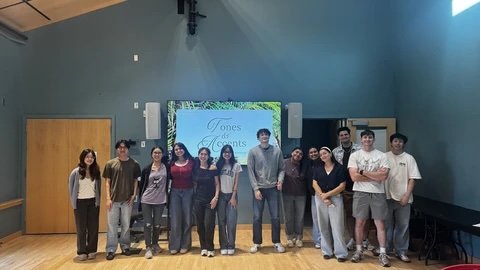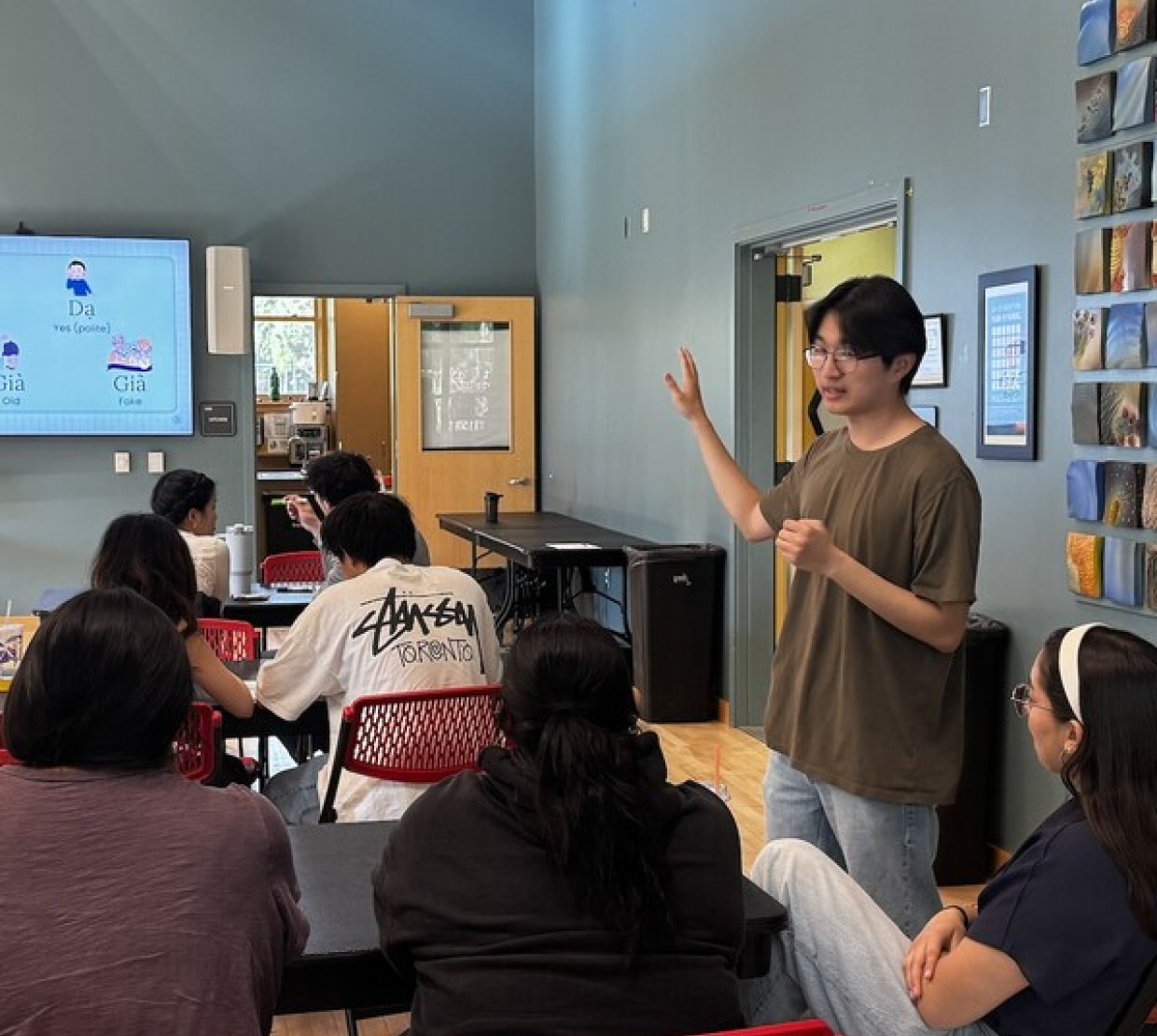
Vietnamese has not been offered as a language course at Oregon State University in 23 years, so senior Ashley Tran decided to start a club last winter and teach it herself.
“I love learning languages. It connects a lot of people,” said Tran, a College of Science biochemistry and molecular biology major who is now minoring in Spanish. “I always felt like being able to speak Vietnamese was a huge part of my own identity, and I felt like, ‘Why don’t we all learn more languages? This is awesome!’”
Though the club is still working on getting formal approval by Student Organizations, members started meeting in February, around the time the university removed several Asian-language minors due to low enrollment.
“Not a lot of people were signing up for them, but I felt like we need this,” Tran said. “There are so many students who identify within these cultures, and also so many students who would probably like to learn, just not as a minor or for anything official.”
She founded the club to provide a space for anyone — not just students, and not just people with Vietnamese background — to start learning the language along with some Vietnamese culture and history. Tran’s sister and cousin are two of the club’s officers, with additional officers coming on board via connections through the Asian & Pacific Cultural Center and the larger community at OSU.
Tran makes her own lesson plans and slides to present at twice-monthly meetings, which so far have drawn 12 to 15 regular attendees. Each lesson includes grammar, sentence structure and a little history when relevant, but the bulk of the meeting is spent learning common words and phrases. A pre-Halloween meeting included holiday-themed words like “pumpkin” and “autumn.”
Tran is currently taking a course on phonetics and pronunciation with Adam Schwartz, associate professor of language, culture and society in the College of Liberal Arts and now the club’s advisor. Learning the international phonetic alphabet in that class has helped her explain correct pronunciation, which is especially important in a tonal language like Vietnamese where words can have totally different meanings depending on vocal fluctuation.
Club members come with a wide range of Vietnamese experience, including many second-generation Vietnamese students who didn’t speak the language growing up, but are eager to learn more to better connect with family members who do.
Tran grew up in Roseburg speaking Vietnamese at home until she and her brother got to elementary school and switched to predominantly English. When they moved to Tigard, home to a much larger Vietnamese community, her parents sent her to Vietnamese school every weekend — something she hated at the time for the added pressure and homework.
“But I’ve learned to appreciate that my parents made me go, as it really instilled in me my love for languages,” she said. “Especially with immigrant families, language is a little harder to keep. Not all parents want to teach it, or they might not have the resources.”
Vietnam has three major accent groups, northern, central and southern. Tran grew up speaking the southern dialect with a northern accent, because while her family originally hailed from the north, her grandparents moved south due to political conflicts during the Vietnam War. The syntax and pronunciation of the regional accents are very different, so Tran works to incorporate all three into her lesson plans.