Physics Major

Exploring the universe from neutrinos to neutron stars

Physics Major

Exploring the universe from neutrinos to neutron stars
Scott Clark standing in front of fence

"The exposure to high-level research gave me the ability to tackle complex problems at the interface of mathematics, physics and computer science."

Scott Clark (Physics and Mathematics '08), Co-Founder and CEO of the artificial intelligence start-up SigOpt.

Program overview

  • Department: Physics
  • Degrees offered: Bachelor of Science, Bachelor of Arts, Honors Bachelor of Science, Honors Bachelor of Arts
  • Physics minor: Learn about the physics minor
  • Graduate program: Master of Science, Master of Arts, Doctor of Philosophy. Learn about the physics graduate program

Physics explores how the universe works by uncovering the fundamental laws that govern matter, energy and natural forces. From the smallest particles to the largest galaxies, physics helps us understand the forces that shape the world around us — and provides the foundation for many of the technologies that power modern life.

A physics degree is a powerful foundation for a wide range of careers. You’ll develop strong analytical, quantitative and problem-solving skills valued across many professional fields. Because physics often intersects with disciplines such as biology, chemistry, computer science and engineering, physicists play a key role in technological breakthroughs — from lasers to computers and beyond.

At Oregon State, physics students build these skills through hands-on research, close collaboration with faculty and opportunities to apply physics to real-world problems.

Physics grads find careers in many sectors, including technology, finance, data science, engineering and even entrepreneurship. The ability to analyze data, think critically, and solve complex problems makes physicists well-suited for STEM positions. OSU physics majors have gone on to become hardware engineers, data scientists, medical professionals, professors, CEOs and more.

Many physicists pursue careers in research at universities. Our internationally recognized faculty explore the universe on every scale — from solar energy to gamma-ray bursts to artificial intelligence. Our research covers:

  • Astrophysics
  • Biophysics
  • Condensed matter experiment and condensed matter theory
  • High energy physics
  • Optical physics
  • Physics education research
  • Quantum mechanics and quantum cosmology

Check out our department's research
Closeup of a student using optical equipment in a physics lab at Oregon State

Studying physics at Oregon State

Our nationally recognized Paradigms in Physics curriculum reshaped how physics is taught and continues to transform how students learn the subject. You’ll develop expertise in core areas such as electromagnetism, thermodynamics, statistical physics and quantum mechanics while building skills through rigorous coursework and hands-on laboratory experience.

The physics major offers both a B.S. and a B.A. degree. The B.A. is designed for students who want a broader academic background, including a second-language requirement and additional liberal arts coursework. The B.S. is ideal for students interested in careers in physics or related fields, or for those planning to pursue graduate study.

At OSU, you can choose from eight options that prepare you for competitive graduate programs and a wide range of career paths.

The option in Applied Physics combines upper-division physics and engineering courses with core courses in mathematics, chemistry and physics as well as project-driven laboratory experience in computational physics. This option is ideal for students interested in studying and in pursuing jobs at the intersection of science and technology.

The option in astrophysics integrates foundational and advanced coursework in physics, astronomy, and computational methods to explore the physical laws governing celestial bodies and the universe as a whole. This option is well-suited for students interested in careers in space science, astronomy, data-intensive physical sciences, or graduate study in astrophysics and related fields.

The Biological Physics option allows students to focus part of their course load on work in the field of biophysics — a field that uses the tools and techniques of physics to solve biological problems, ranging from human systems to biological macromolecules and protein structures. Students interested in biophysics research and industry careers will find this option valuable.

The option in Chemical Physics will help students learn about chemistry processes and phenomena through the perspectives of atomic and molecular physics. This option will prepare you for careers in research as well as a wide range of industry jobs related to chemical engineering.

The Computational Physics Option will allow students to study upper-division physics courses in quantum mechanics and electronics and computational science courses in programming fundamentals and mathematical computations, in addition to a number of other topics. This option opens up pathways to exciting jobs in national research laboratories as well as a number of industry jobs that rely on computational models, tools and methods.

The option in geophysics integrates core courses in physics, chemistry and mathematics to understand the the processes that operate on and in Earth, such as gravitational, seismic, geothermal and other phenomena. Students will study upper-division physics courses in electromagnetism, dynamics of mechanical and electrical oscillation, thermal and statistical physics, among other topics. This option is tailored for students interested in employment opportunities in a wide variety of geosciences, environmental sciences and geotechnical fields as well as graduate school in geology, Earth Science and allied areas.

The option in mathematical physics is intended for students interested in theoretical physics and the intersections between mathematics and physics. The option includes upper-division core and elective courses in statistical mechanics, computational physics, vector calculus and quantum mechanics. Students will gain an understanding of the theory and applications of physics and mathematics and can endeavor to work in either field.

The option in physics teaching is well-suited for students who are keen on teaching science at high school or the secondary school level. Students will complete at least eight credits in physics education electives that integrate science and literacy learning for prospective teachers.

B.A. Degree

The flexible physics major also offers a B.A. in physics. For students of the liberal arts, the study of physics provides an introduction to modern ideas about the most fundamental and elemental aspects of nature and how those ideas developed in their cultural and historical context.

The B.A. degree requires fewer physics courses but more courses from the College of Liberal Arts; in addition, second-year proficiency in a foreign language is required for the B.A. degree.

The BA degree in Physics is appropriate for physics students interested in obtaining a broader academic background through a second-language requirement and additional liberal arts courses. This degree may lead to international opportunities, especially if coupled with the International Degree Program at OSU.

Learn more about your physics curriculum

Wondering what kind of classes you'll take? Your physics major includes in-depth curriculum, including courses like

  • Galaxies, Cosmology, Life in the Universe
  • Physics of Contemporary Challenges
  • Paradigms of Physics: Quantum Fundamentals

Want to know more about coursework requirements? Use the OSU Catalog to learn more about:

  • your typical sequence of courses
  • what pre-requisite courses you'll need
  • your major's core curriculum

What does your four-year course load look like as a physics major? Check out this sample plan for one example of how to map out your academic journey.


VIDEO: What's it like as a physics major?

Meet Christopher, a physics major at Oregon State’s College of Science. A love of space and Star Wars — as well as a visit to the rooftop of Weniger Hall — led him to switch majors and pursue a physics degree. At OSU, Christopher discovered a warm, welcoming community of science student clubs. He also discusses the research opportunities that set the stage for future success.

Hands-on learning experiences

What makes a physics degree from Oregon State better? One big reason: Our hands-on learning experiences! Science is often a competitive career field — these experiences give you the real-world skills to support your future goals.


Undergraduate Research

This is your chance to see up close what it means to be a scientist. Don’t just study science in the classroom — get in a lab and contribute to it, working alongside world-class faculty!


Internships

Practice your science in a professional setting. An internship with a real-world employer is the perfect opportunity to experience what your future career in science could look like.


Study Abroad

Our students’ work spans the globe! Immerse yourself in another culture to gain a global perspective in your studies.


Clubs/Organizations

Here’s your chance to discover like-minded communities of peers who share your interests! Come together and engage in meaningful ways.


Academic support

Team Science is here to help you thrive. Our student support is another reason we always say, "science is better at Oregon State." You'll have access to a wide array of support services and resources designed to thrive both in and out of the classroom. Here are some places to get started:

Student resources

At OSU, support comes in a LOT of forms — here's where to start. From our Science Success Center to health and wellness resources, connect with the support you need to thrive as a college student.


Learning Assistant (LA) Program

Love learning in smaller, collaborative group settings? Our Learning Assistant Program combines small-school attention with big-school resources. Your LA group replaces traditional lecture formats with active learning strategies, maximizing the way you engage with your STEM courses.


Tutoring Centers

Our tutoring centers are welcoming, friendly spaces where peer and faculty mentors offer guidance and share study techniques to help you grasp course materials and improve your academic performance.


Advising

Your physics advisor is there to help you navigate your academic path, helping you select the right courses and achieve your future goals. They'll ensure that you are connected to the resources our department and the university have to offer to help you make the most of your time in college.


And of course, you can always reach out to our student Peer Advisors at sciencesuccess@oregonstate.edu with questions, as well! Our Peer Advisor team is friendly, helpful and can share their first-hand knowledge of the Oregon State experience.

Careers in physics

What jobs can you get with a physics degree?

With a physics degree from OSU, you can pursue a wide range of career paths.

Here are just several examples of career pathways our physics alumni have followed:

  • Camera Hardware Engineer | Apple
  • Assistant Professor | Troy University
  • Graduate students | Princeton, Stanford, Brown, UT-Austin
  • Quality Engineers | Crane Aerospace & Electronics, Mentor Graphics
  • Advanced Development Engineer | KLA-Tencor
  • CEO & Founder | PVBid
  • Emergency Medicine Resident | University of Central Florida
  • Process Engineers | Intel, SkyWater Technology Foundry
  • Research Scientist | Saint Gobain Crystals
  • Postdoctoral Fellow | Berkeley Lab

Student and alumni stories

A man in jeans and a t-shirt sits outside on a building's steps, smiling.
Kyle Gourlie, Class of ’25: Small-town student to space-time researcher

There’s the store, the gas station and fields that stretch to the hills. Describing his home in Scio, Oregon, physics senior Kyle Gourlie emphasizes its small-town lifestyle. Getting access to science in his rural community, however, proved to be a challenge.

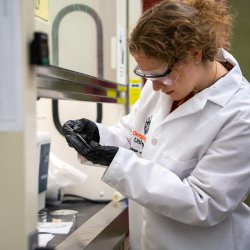
A student with her hair pulled back wearing a lab coat and protective goggles looks intently at the glassware in her hands.
Perseverance and photovoltaics: Goldwater Scholar paves future in nanoscience

Physics senior Madalyn Gragg was named a 2024 Goldwater Scholar, the nation's top STEM award for undergraduates. Being recognized from more than 5,000 applicants, she hopes her success inspires others to break down their own barriers into science.

Sullivan Bailey-Darland in front of an urban backdrop.
A ‘limitless degree’: Physics senior pushes the boundaries of his field

How does DNA move? How do cells communicate with each other? When it comes to these questions, it’s easy to think of molecular biologists behind the words. But as physics and mathematics senior Sullivan “Sully” Bailey-Darland knows, there are many more voices asking.

Abbie Glickman wearing graduation cap
An outstanding physics education powered by undergraduate research

Native to Edmonds, Washington, graduating senior Abbie Glickman credits her high school physics teacher for helping her see how she could apply mathematical concepts to understand the physical world around her. “When I took physics the first time, he made sure that I knew that I belonged in physics,” she said.

Physics student Diego Menendez leans on a large white column at Memorial Union Hall at Oregon State University. He has his arms crossed in front of him and he smiles at the camera. The hall behind him stretches on with a series of large white columns.
Physics student dedicated to increasing access to STEM

Physics student Diego Menendez will begin classes for his final year at Oregon State during Hispanic Heritage Month 2024, right after his last LSAMP bridges experience as a program mentor. When asked what Hispanic Heritage Month means to him, he said, “I feel like during that month and other identity-based celebration months, people are just so proud of where they come from, who they are, and their lineage, their people, their families. I love that. I'm a very proud Cuban all the time.”

A woman with shoulder-length hair wears an earset microphone and presents to an unseen audience
Black holes devour light — except when they create it, finds physics undergrad

When physics senior Phia Morton flew to Italy to do research, she couldn’t have imagined what she’d find hidden in the stars: the first strong candidate of a black hole merger emitting light. This discovery deepens knowledge on the cosmic structures and may even give a new opinion on how quickly the universe is expanding.