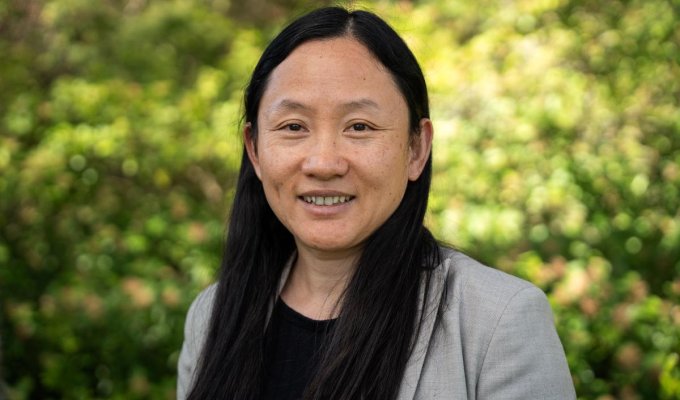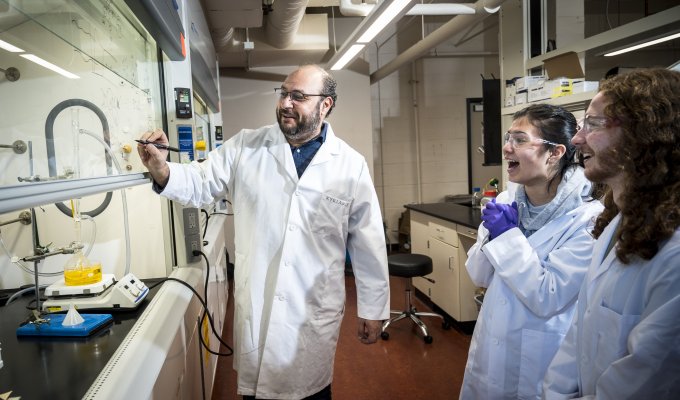
A team of scientists led by chemist Chong Fang has discovered a new way to visualize and track chloride ions in living systems, opening the door to accelerated research on diseases like cystic fibrosis, epilepsy and certain cancers.
A College of Science alumna and a Ph.D. student have been awarded 2025–26 Fulbright U.S. Student Program grants to conduct research abroad. They join 17 College of Science students and alumni who have earned Fulbright honors over the past decade.
A research team in the College of Science has revealed how cells move lipids — essential fats — between membranes, a process fundamental to brain health, metabolism and immunity.
Maude David’s research sits at the crossroads of microbiology, neuroscience and artificial intelligence — an intersection that may hold the key to understanding some of the most complex disorders affecting the human brain and unlocking the secrets of deep-sea ecosystems.
Join us for the 2025 F.A. Gilfillan Memorial Lecture, featuring Dr. Elisar Barbar, a pioneering researcher challenging traditional views of protein structure.
The College of Science community recently gathered to celebrate this year's Alumni Award recipients. These individuals have enriched many lives through their professional achievements, impact and service. They embody our vision to extend the reach and impact of science by improving life for the people of Oregon and beyond.
For billions of years, all life on Earth, from tadpoles to humans, have relied on the same 20 amino acids to build proteins — the fundamental building blocks of life. But what if that list of fundamental amino acids was expanded to include any chemical ability of our choosing? What new potential could be unlocked?
Catherine Sterrett has always been called to medicine, but when she found herself as a patient, compassion became her greatest motivation. Now a graduating senior, she looks forward to where her career will take her.
Cities are like organisms — they need immune systems. Viruses can reproduce rapidly, taking over cells and turning them into viral factories within hours. Individuals' immune systems need to rise to the challenge, but what happens when they can't, and a whole population gets sick?
Rebekka Toyoizumi has always admired the big questions that science has to offer. A graduating biochemistry and biophysics major at Oregon State, she spent six months throughout summer and fall 2023 terms at OSU exploring those questions through an experiential internship. She is excited to continue this work for the multinational biotech and biopharmaceutical company, AstraZeneca, in Maryland following graduation.
Collaborative science has the power to change the world. The 2024 College of Science Research and Innovation Seed (SciRIS) award recipients aim to use that power to develop better treatments for cancer and unlock the mysteries of complex mathematical equations.