A group of people at a conference.

What does an actuary do? Erica Baird’s path from math student to industry leader

By Hannah Ashton

Erica Baird and her coworkers at a shareholders meeting in Phoenix in 2026, along with the chairman of the board and CEO of Milliman.

Erica Baird (’05, M.A. mathematics ’09, Ph.D. mathematics and statistics ’13) didn’t set out to become an actuary. In fact, when she first heard about the career as an undergraduate mathematics student at Oregon State University, she was skeptical.

“I thought it was a scam,” she said. “You go and take all of these exams and then you get this great high-paying job and all you need is a bachelor’s degree.”

That skepticism didn’t last. As Baird learned more about the profession and the rigor behind its credentialing process, she began to see actuarial science as a disciplined field grounded in mathematics, data and real-world impact.

Today, Baird is a principal and consulting actuary at Milliman, where she leads research and development for a risk-adjustment software product while advising clients across the health care industry. Her path from southern Oregon to a leadership role in a global consulting firm was driven by a desire to use mathematics to tackle complex challenges that affect patients and health care systems.

Four people sit and pose for a photo in front of trees.

Baird and her husband Kyle pose for a photo with Baird's parents at the Trees of Mystery in California.

What is an actuary?

At its core, actuarial science uses mathematics, statistics and financial theory to manage risk and inform decision-making. While the work is rooted in numbers, it is ultimately about helping institutions understand what could happen in the future — and how to plan for it.

The profession is structured around four main practice areas: health, life, property and casualty, and pensions. Each track focuses on a different kind of risk and requires specialized knowledge of industries, regulations and financial systems.

Health actuaries, like Baird, work with hospitals, insurance companies and government programs to analyze medical costs, design insurance pricing and evaluate how healthcare services are funded and delivered.

“We’re trying to make sure that their prices are fair, and that they are financially stable,” she said.

Baird started at Milliman as an actuarial analyst, supporting a software product designed to predict individual health care costs using past claims data. She trained predictive models, validated them and answered client questions.

Over time, her role expanded. Baird discovered she excelled in consulting, working directly with clients to solve unique problems. She now leads research and development for the software product and holds a senior-level position on the consulting side. Her work ranges from pricing Medicare plans to helping hospitals understand payment models to evaluating how successful medical interventions are at improving patient outcomes.

A group of people hold hands and jump into a lake for a polar plunge.

Baird and her coworkers jump into a frozen lake for a polar plunge to benefit Minnesota Special Olympics (Baird is third from the right and her husband, Kyle, is fourth from the right).

“My days are never boring," she said. “Clients bring us hard problems and we get to design studies, build models and really dig into whether something is working.”

No two assignments look the same, she said, because no two clients are trying to solve identical problems. That variability is part of what keeps the work engaging: each project requires adapting models, interpreting data in context and explaining results to non-technical audiences.

While insurance can be a complex and sometimes frustrating system for consumers, Baird emphasizes the broader mission behind the work.

“It can be tricky, but it can also save lives,” she said. “We aren’t just there to help insurance companies make more money. We’re there to help them serve the people that need health care.”

In January 2026, Baird joined the Actuarial Standards Board, which sets standards that actuaries in the U.S. must follow in their work. It also oversees updates to those standards through volunteer expert task forces and public comment, helping ensure consistency and professionalism across the field.

“It's been a great experience because they’re all people who are really passionate and excited. We spend a lot of time in passionate discussions and debates, making sure we think through all the implications of the guidance that we’re creating. Am I setting the bar too high for actuaries? Or am I not setting it high enough?”

A woman poses with a giant sign that says "Love RUH."

Baird poses with the Love RUH sign in Riyadh, Saudi Arabia during a work trip.

Baird’s take on how to become an actuary

Baird grew up in Central Point, Oregon, and was interested in pursuing a degree in education, but a high school calculus class shifted her trajectory.

“I really enjoyed the problem-solving aspect of it,” she said. “It felt like the first time you moved beyond mechanics and got to how we use math to solve problems.”

That realization led her to pursue mathematics at Oregon State, where she eventually completed her undergraduate degree, master’s degree in mathematics and a dual Ph.D. in mathematics and statistics.

Her interest in actuarial science didn’t take hold until graduate school. After taking her first probability course, she began to see new possibilities, deciding to take her first actuarial exam while she was still in school.

Becoming an actuary requires a series of rigorous professional exams that unfold over several years. Candidates complete seven exams and a series of modules and other courses to reach Associate status, with several additional exams and modules needed to be fully credentialed as a Fellow. Most candidates study while working full-time, turning the exam process into a parallel track of education and career experience.

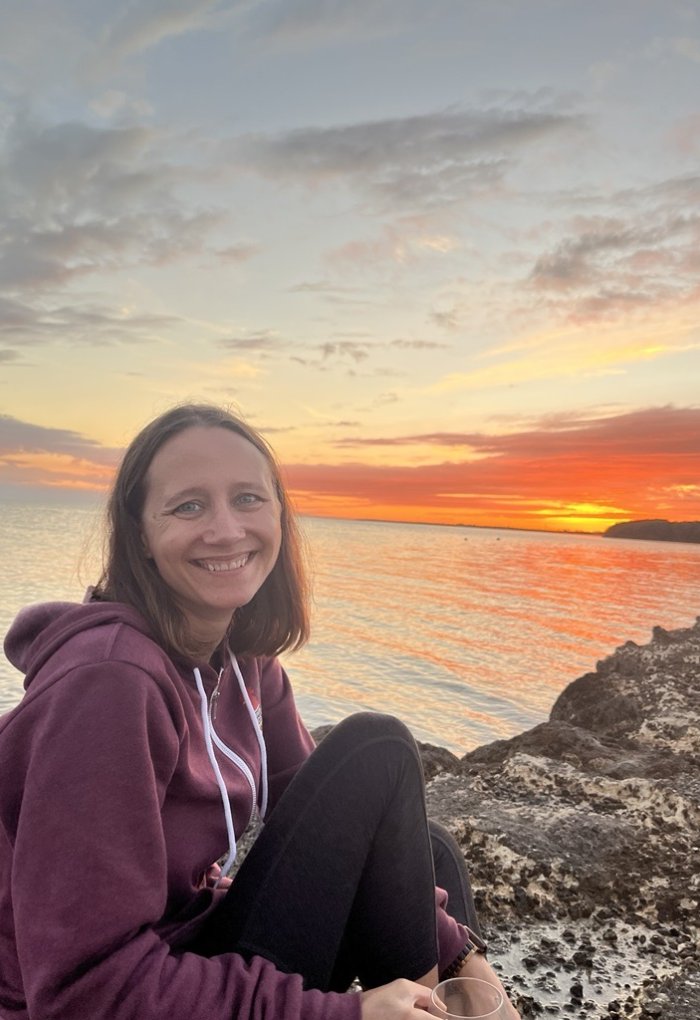
A woman poses for a photo in front of an orange sunset over water.

Baird poses for a photo during sunset in Key West during a work trip.

Always being open to learning benefited Baird when she started at Milliman. New terminology, processes and expectations felt overwhelming. Although she credits her graduate training for helping her develop critical skills like note-taking and technical writing, it took her time to adjust.

“For the first six to eight months, I felt completely out of my element,” she said.

Doubting yourself in a new role is a normal experience, Baird said, but those feelings won’t last forever. Over time, that uncertainty gave way to confidence and she took on leadership roles.

For students interested in actuarial careers, Baird recommends gaining early exposure to the field by taking exams and pursuing internships. Equally important are soft skills.

“We’re a very collaborative group,” she said. “Making sure that you can show that you have successfully worked as part of a team or led a team is helpful.”

Actuarial work goes beyond spreadsheets and equations; it’s about using math to guide decisions that affect people’s lives. From shaping how healthcare is delivered to ensuring organizations can meet their financial commitments, that work carries real consequences. For Baird, it’s a job that lets her use mathematical skills in ways that have real-world impact.