A man in a sweatshirt stands in front of a blue background.

Scott Clark's vision for AI-powered discovery keeps scientists at the center

By College of Science

Scientists spend hours wrangling data, rebuilding experiments, troubleshooting code and keeping track of each step. Alumnus and entrepreneur Scott Clark (’08) believes that artificial intelligence can take on much of that work, freeing researchers to pursue the questions that drive discovery.

He’s putting that belief into practice with Tolaria Scientific, a new platform designed to automate the painstaking work of scientific validation while keeping researchers in control of the process.

During a recent lecture hosted by the College of Science, Clark shared three beliefs he hoped the audience would take away: AI and science can create abundance, researchers will remain essential to discovery and better tools can help accelerate scientific progress.

“How do we live in a sci-fi future?” Clark asked. “How do we get to a world where we can fundamentally improve quality of life, not just replace repetitive work?”

Clark earned bachelor’s degrees in mathematics, physics and computational physics before completing a doctorate in applied mathematics at Cornell University. He has spent much of his career at the intersection of AI and scientific problem-solving.

A man in a cap and gown holds three diplomas.

Scott Clark smiles on graduation day in 2008, holding his three B.S. degrees in math, physics and computational physics.

In 2014 he founded machine learning optimization company SigOpt, later selling it to Intel, where he served as vice president of AI and high-performance computing. He is now the founder and CEO of Distributional Inc. and is developing Tolaria Scientific, a platform aimed at accelerating research through AI-assisted workflows.

“I believe that ideas, imagination and intuition is what actually drives science forward,” Clark said. “But the biggest bottleneck is testing them.”

Where scientists fit in an AI future

At the heart of Clark’s talk was a question many researchers are asking: If AI continues to improve, what role will scientists play?

His answer drew on two well-known ideas in artificial intelligence. The first is an observation from researcher Richard Sutton called the “bitter lesson.” This concept suggests that enough data and computing power can outperform even the most carefully designed human solutions.

“Instead of coming up with a really clever way to detect whether or not there’s a cat in a photo, and saying this is what a cat looks like and here’s how you can tell where the ears are, you can just give a computer a million examples and have it figure it out.”

The second idea, the “no free lunch” theorem, argues that specialized knowledge still matters when solving specific problems. This feels at odds with the “bitter lesson.”

Rather than viewing the ideas as contradictory, Clark described them as opposite ends of a spectrum. As AI continues to improve, it will absorb more of the problems that are well understood and rich in data. This frees researchers to explore the unanswered questions and emerging problems that lie beyond the boundaries of existing knowledge.

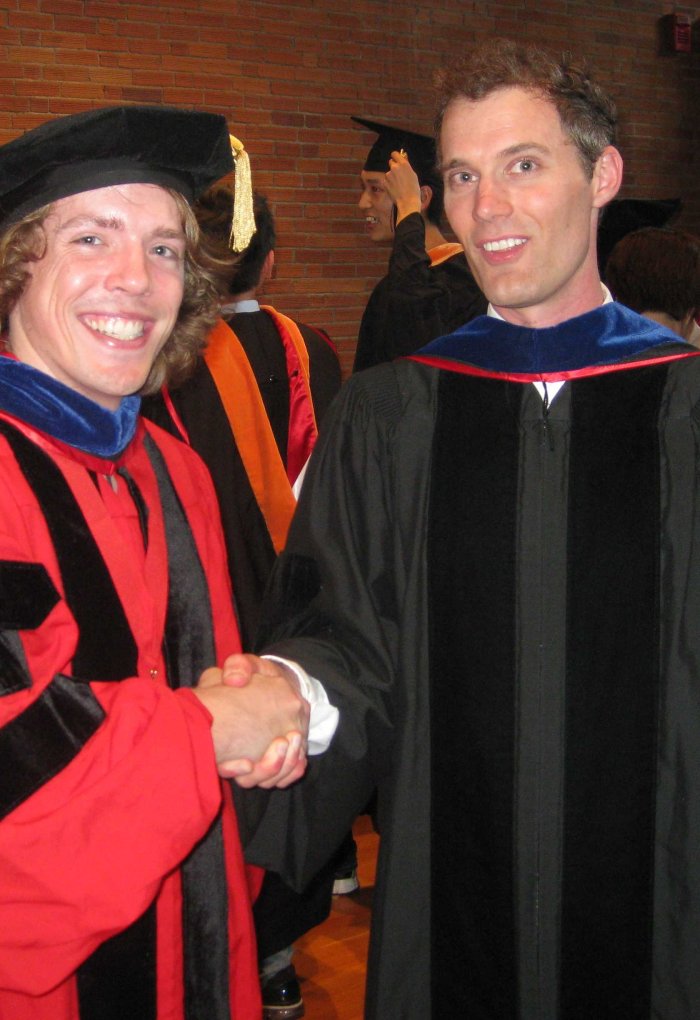
A man in a cap and gown shakes the hand of his Ph.D. advisor.

Scott Clark shakes that hand of his Ph.D. advisor, Peter Frazier, after getting his hood on graduation day at Cornell University in 2012.

Instead of worrying about AI taking jobs, Clark says to think of humans and AI together.

“What can we do with a portfolio of solutions where the human pushes us out of distribution and the machine comes in and fills in behind?”

A harness for scientific discovery

That portfolio is the idea behind Tolaria Scientific which Clark calls a “harness,” a structure placed on top of an AI model to keep it on a specific, verifiable path, much as a harness allows someone to direct an animal.

The goal is to hand off what Clark calls the “validation schlep.” This includes wrangling data, porting code to new computing environments, rebuilding baselines from decades-old papers and restarting a job that crashes at 3 a.m.

The tool can automate repetitive tasks, run experiments and track results so researchers can understand and replicate their work. Throughout the process researchers remain in control and make scientific judgments.

Faculty members pressed him on what might be lost with more AI involvement. One posted that struggling through someone else’s code is how researchers uncover unnoted choices and build intuition. Clark acknowledged the trade-off. He said he favors augmenting scientists rather than automating them, with a human approving each step, and that better teaching will need to accompany better tools.

Another audience member asked how a harness differs from simply asking a general-purpose AI model to do the same job. Clark said that “sometimes having an 80% solution is worse than having no solution,” because users can’t tell when to trust it. The harness, he said, makes repeatable steps deterministic.

On mentoring, Clark said he hopes the tools let students ask their own questions sooner and “make mistakes earlier and faster,” with advisors still guiding the process. When asked how academic researchers can compete with far better-resourced corporate labs, he said open-source tools and open models can help level the field.

Tolaria Scientific is in private beta and is scheduled to launch as open-source at the NeurIPS conference in December. Clark said he plans to make it free for researchers, as he did with SigOpt, and invited faculty working in computational physics and related fields to talk with him.

His larger aim, he told the audience, is “abundance through discovery,” a future researched faster by scientists who spend less time on the routine and more time on the questions only they can ask.

Learn more about his work and watch his talk.