Students wander around looking at thesis posters.

OSU Honors College degree for science students, built around undergraduate research

By Hannah Ashton

Students take part in the 2025 spring Honors College Thesis Fair.

Science students at Oregon State are driven by curiosity. They want to ask big questions, join research teams early and build strong relationships with faculty. The Honors College gives them an additional space to do that. Nearly 14% of College of Science students choose honors — double the university-wide percentage — because it opens more doors.

For science majors balancing heavy course loads, research ambitions and competitive postgraduate pathways, the Honors College offers structure, access and support that can elevate their experience.

At OSU, that support is anchored in a rare distinction: unlike universities where honors is a transcript notation, honors students earn a unique degree at OSU. And the benefits don’t stop there: Honors science courses double down on engagement between and among faculty and students alike. Early research opportunities to support required honors thesis turns undergraduates into published scholars. At multiple levels, OSU’s Honors College delivers an educational model that deeply aligns with the goals of future scientists.

Research: the heart of the Honors College experience

The emphasis on research begins early, with some science students finding opportunities through honors in their first year — an experience echoed across the College of Science for all students who proactively pursue opportunities.

Eleanor Courcelle, an Honors mathematics and chemistry major, discovered her current research mentor after seeing her present at an Honors College Faculty Research Showcase. She reached out afterward, and that connection led to a funded URSA project and ultimately her honors thesis, which applies mathematical modeling to biological systems.

Biochemistry and molecular biology Honors senior Katya Karlapati had a similar experience. As she settled into her major, she realized she didn’t want to wait to get hands-on research experience.
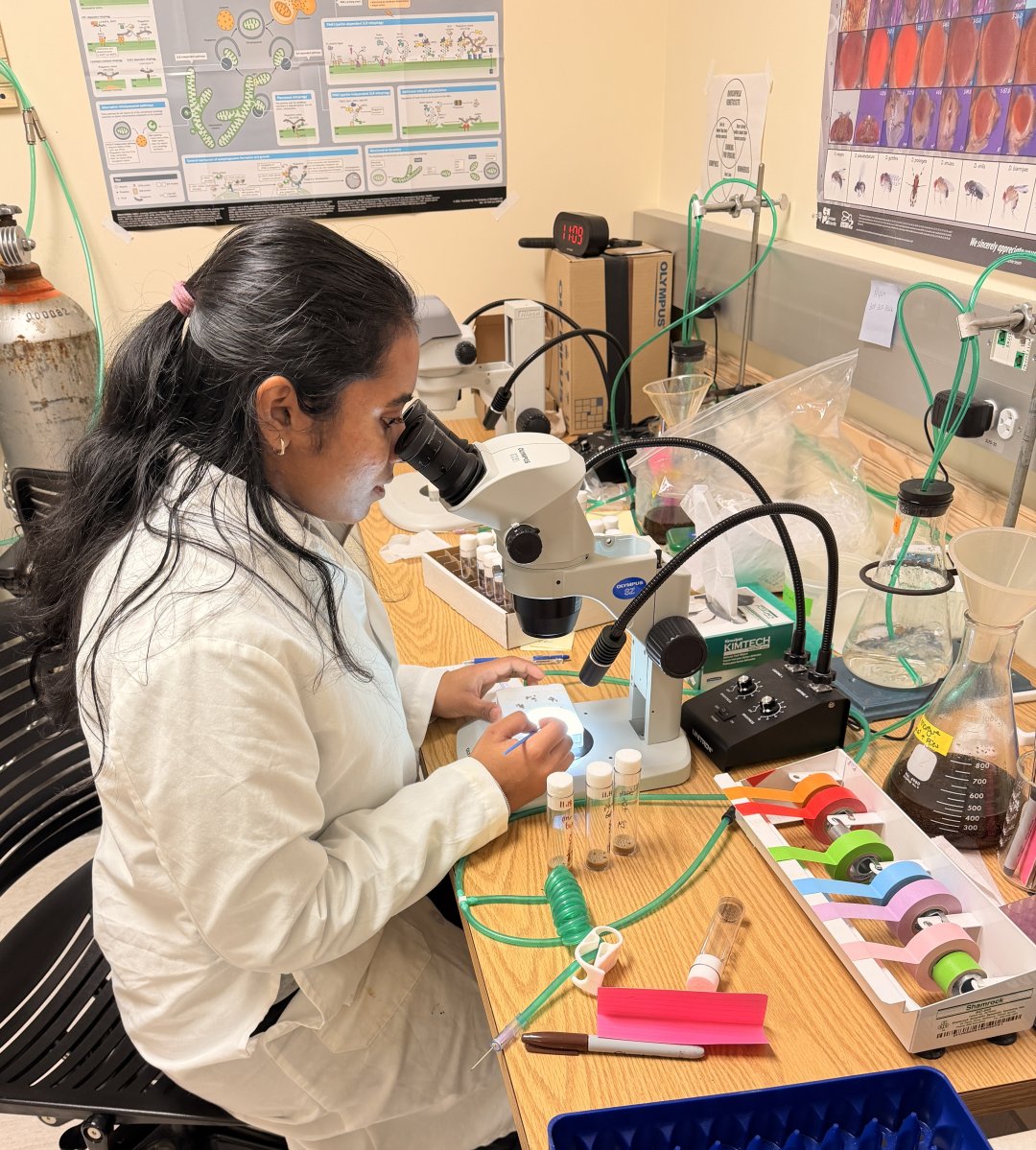
A woman with black hair sits at a table and looks into a microscope.

Katya Karlapati is part of Alysia Vrailas-Mortimer's laboratory. Her lab explores how different factors such as aging and exposure to toxins contribute to neurological disorders and muscular dystrophies. Vrailas-Mortimer uses fruit flies as a model organism.

“Research helps drive a field forward, and it’s really at the forefront of giving better patient care or improving medications,” she said. “The Honors College really helped give me opportunities and gave me a structure because I knew we had to do a thesis.”

Karlapati ended up in Alicia Vrailas-Mortimer's lab, a fly lab that focuses on Alzheimer’s research. This became the cornerstone of her thesis, which examines different mutations that can accelerate the development of Alzheimer’s in flies and lead to neuron death.

When science students reach out to faculty, she said, being in honors signals commitment.

“Professors know you have to do your thesis and you’re willing to put in that extra mile,” she said.

For students eyeing medical, dental or graduate school, the thesis shows a level of scholarly ability that stands out. Every honors thesis is published on OSU’s open-access ScholarArchive, meaning each undergraduate has contributed to a global body of knowledge.

“It is a pathway that sets them apart… they’re making their contribution available to the entire world,” said Honors College Dean Toni Doolen.

A unique honors framework

Unlike many universities where honors is a transcript note or participation program, OSU stands apart as one of the only institutions in the country where honors is its own degree.

Students graduate with an Honors Baccalaureate degree, which is simultaneously conferred with their major. A biochemistry major, for example, graduates with an Honors Bachelor of Science in Biochemistry, a title that signals not just engagement in honors coursework, but academic rigor backed by measurable learning outcomes attached to the honors coursework.

“Our program isn’t just about participation or just taking honors sections of classes that you might normally take a non-honors section of. We have learning outcomes specific to the Honors College, including scholarly inquiry and engaged inquiry,” Doolen emphasized.

Students sit around a table and look towards an instructor in a salmon colored shirt.

Honors College students engaging in an interactive class discussion in a small, seminar-style setting that encourages participation and critical thinking.

The scholarly inquiry learning outcome is fulfilled primarily through students doing independent research or scholarly work under the advisement of a faculty member and a committee that culminates in their honors thesis.

“This helps them grow their writing and oral communication skills. For many students, it also gives them a chance to do a really deep dive into what it looks like to be a scholar and to make a contribution to a body of knowledge,” Doolen said.

The engaged inquiry learning outcome coincides with the Honors College’s belief that students need to be able to communicate outside of their area of expertise. All students are required to complete unique classes to the Honors College called seminars. These courses offer students the opportunity to explore cross-disciplinary spaces that they might not otherwise be comfortable in. Seminars are taught pass or no pass so there is no risk to a student’s GPA.

Karlapati said those courses broadened her academic world.

“They give you an opportunity to learn about subjects in a different way,” she said. “They offer a low-stress environment to learn more and they’re also really fun.”

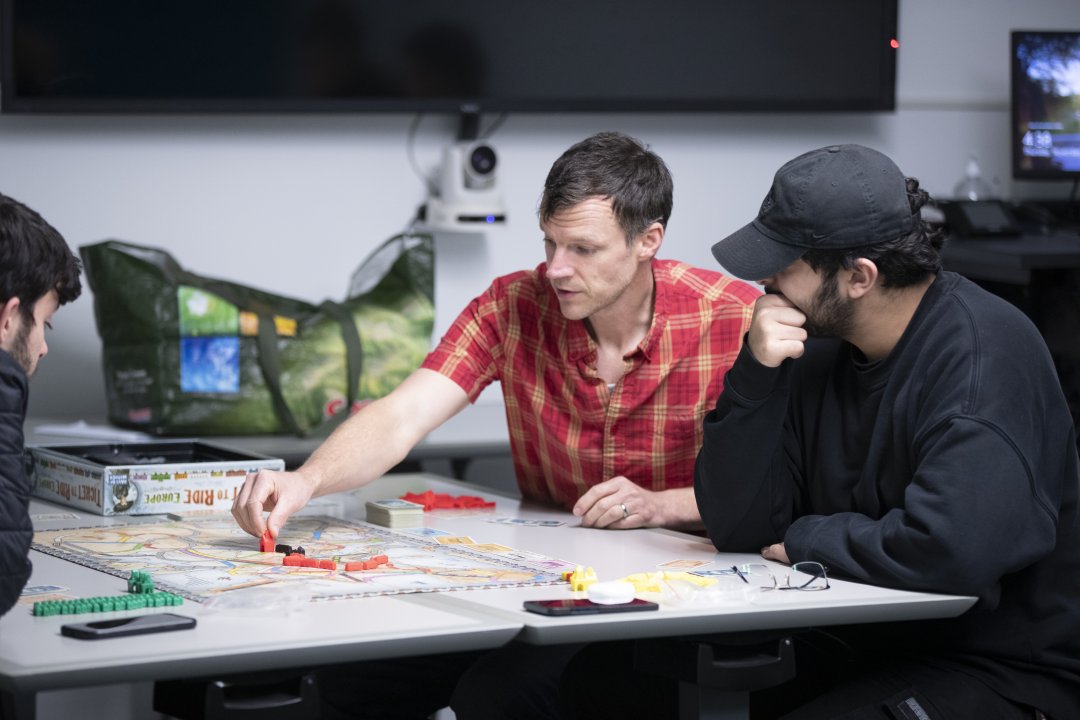
She took classes on leadership, astronomy, fashion and even a course built around board games that examined the history of finance.

For science students accustomed to lab reports and problem sets, that variety is often refreshing and useful.

Two students and a professor sit a table and play the board game ticket to ride.

Students explore the History of Commerce through board games in an Honors College seminar. This unique course uses interactive gameplay to examine the evolution of trade, finance and economic systems in a fun, low-stress learning environment.

Building relationships in a big university

Many students said one of the strongest Honors College benefits is the highly engaged class environment, especially early on in demanding science sequences like chemistry, biology and genetics.

Courcelle said this makes first-year classes less daunting.

“The core honors classes were a lot smaller,” she said. “It made a big difference when I was applying to outside opportunities my first year …. professors knew me well.”

Karlapati agreed. “Especially if you’re just starting out, it can be an easier path to get the help you need,” she said. “It’s a really big help to have that personalized attention.”

Dean Doolen emphasized that while some honors courses are small, others are intentionally large, but use an “engaged pedagogy” marked by interaction, discussion and experiential learning.

Another benefit is community-building opportunities outside the classroom.

Karlapati lived in West Hall, parton of the honors living and learning community, and she said the friendships she made there shaped her entire OSU experience.

“I have suitemates who are going to be my lifelong friends,” she said. “Most of them are the ones going to class with you…it’s great to go into the study room and you’re seeing all your classmates.”

The SLUG — the Honors College student learning space on the Corvallis campus — is another space that supports honors students. "SLUG" stands for Students Learning UnderGround and dates back to the Honors College's early days in Strand Agricultural Hall, when the student learning space was in the basement.

Three students sit at a table.

Honors College students study and collaborate in the SLUG, a dedicated space designed for connection, group work and academic support.

“It’s a great study spot, and the best part is the food,” Karlapati said. “There’s always a meal in there you can take whenever you need.” The Honors College supports students through its Forgot Your Lunch program, which provides food in the SLUG for anyone who forgot their meal or needs a little extra help.

The Honors College provides community for students who might otherwise feel overwhelmed.

“OSU is a big place now,” Dean Doolen said. “For a lot of students, the Honors College is a way of creating a smaller community of like-minded folks.”

A good fit for curious, driven scientists

Both Courcelle and Karlapati say the benefits of honors stack up, academically, personally and professionally.

The college becomes not just an academic distinction, but a launchpad. A hub for friends, mentors, engagement in research and personal and professional growth. A smaller, tighter world inside OSU’s expansive scientific ecosystem.

And for students like Courcelle and Karlalpati, it’s hard to imagine their scientific journey without it.