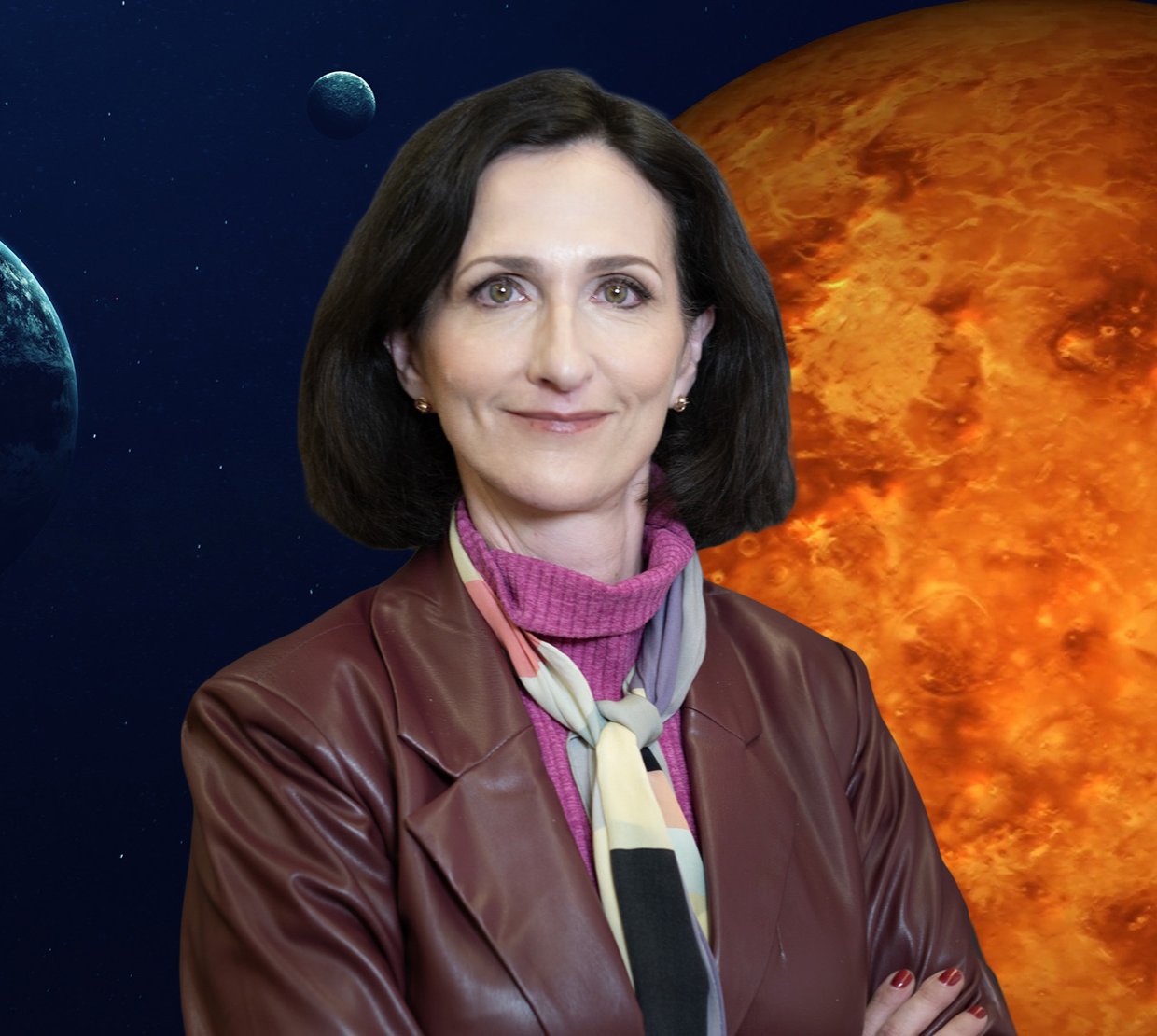
For thousands of years, humanity has wondered whether life exists beyond Earth. Today, advances in astronomy, planetary science and space exploration are bringing researchers closer than ever to answering that question.
On Tuesday, Sept. 29, Oregon State University's Department of Physics will welcome internationally renowned astrophysicist and planetary scientist Sara Seager as the featured speaker for the 2026 Yunker Lecture. Guests are invited to begin the evening with a reception from 4 to 5 p.m. before Seager's lecture. The event is open to students, faculty, staff, alumni and community members.
Seager, one of the world's leading experts on planets beyond our solar system, will present "From Lab to Cosmos: Three Frontiers in the Search for Signs of Life Beyond Earth." Her lecture will explore how discoveries of thousands of exoplanets, studies of planetary atmospheres and new research into unconventional environments for life are reshaping scientists' understanding of where life might exist in the universe.
41st Annual Yunker Lecture
"From Lab to Cosmos: Three Frontiers in the Search for Signs of Life Beyond Earth"
Date: Tuesday, Sept. 29, 2026
Time: 4 to 6 p.m. (4 p.m. reception; 5 p.m. lecture)
Location: Memorial Union, Horizon Room (Room 49)
RSVP for the Yunker Lecture
Expanding the search for life
In her lecture, Seager will discuss three scientific frontiers that are driving the search for life beyond Earth.
One frontier focuses on exoplanets orbiting distant stars and the search for atmospheric gases that could serve as signs of biological activity. Another examines Venus, a neighboring planet whose cloud layers contain temperatures suitable for life, despite being composed of concentrated sulfuric acid rather than water.
Seager's research team has conducted laboratory studies showing that some important biomolecules can remain stable in sulfuric acid, opening new possibilities for how and where life might exist. The work challenges traditional assumptions that life must rely on water and broadens the range of environments scientists may consider when searching for biological signatures.
By exploring worlds unlike Earth, researchers hope to increase the chances of detecting signs of life elsewhere in the cosmos while bringing together expertise from astronomy, planetary science, chemistry, physics and emerging technologies
A pioneer of the exoplanet era
Seager has worked at the forefront of exoplanet research since the field emerged in the late 1990s. When astronomers first detected a planet transiting a star beyond our solar system in 1999, she was developing the theoretical framework for studying the atmospheres of those distant worlds.
At the time, the idea of measuring the chemistry of an exoplanet atmosphere seemed extraordinarily ambitious. Today, it has become one of the most powerful tools available to scientists searching for evidence of habitability and life beyond Earth.
The field has expanded dramatically over the past three decades. More than 6,300 exoplanets have now been confirmed, revealing that planets are common throughout the galaxy and that many rocky worlds may be very different from Earth.
"Sara has worked at the cutting edge of exoplanet discovery since the field was born," said Ethan Minot, head of OSU's Department of Physics. "Her ideas were bold, the underlying physics was sound, but it was the kind of idea that could take a lifetime to achieve. It will be thrilling to hear her tell the story of how this field was born, how vision and boldness overcame skepticism, and where the field stands today."
About the speaker
Sara Seager is an astrophysicist and the Class of 1941 Professor of Planetary Science, Professor of Physics, Planetary Science, and Aeronautics and Astronautics at the Massachusetts Institute of Technology. Her research spans the detection of exoplanet atmospheres, the search for signs of life beyond Earth and the development of novel space mission concepts. She served as Deputy Science Director for the MIT-led NASA Explorer-class mission TESS, led the Starshade Rendezvous Mission concept for direct imaging of Earth-like exoplanets and leads the Morning Star Missions to Venus, a series of privately and publicly funded missions searching for signs of life in Venus's atmosphere.
Her honors include a MacArthur Fellowship, membership in the U.S. National Academy of Sciences, the Kavli Prize in Astrophysics and recognition as an Officer of the Order of Canada. She is the author of The Smallest Lights in the Universe: A Memoir. In October, Professor Seager will move to the University of Toronto to serve as North Star Distinguished Professor at the Canadian Institute for Theoretical Astrophysics.
With a longstanding tradition since 1985, the Department of Physics Yunker Lecture was established in honor of Edwin Yunker, an Oregon State University physics professor (1925-68) and department chair (1949-66), by his wife, Gertrude and sustained by other family members through the years to ensure outstanding physicists presented lectures on specific areas of expertise for a general audience.


