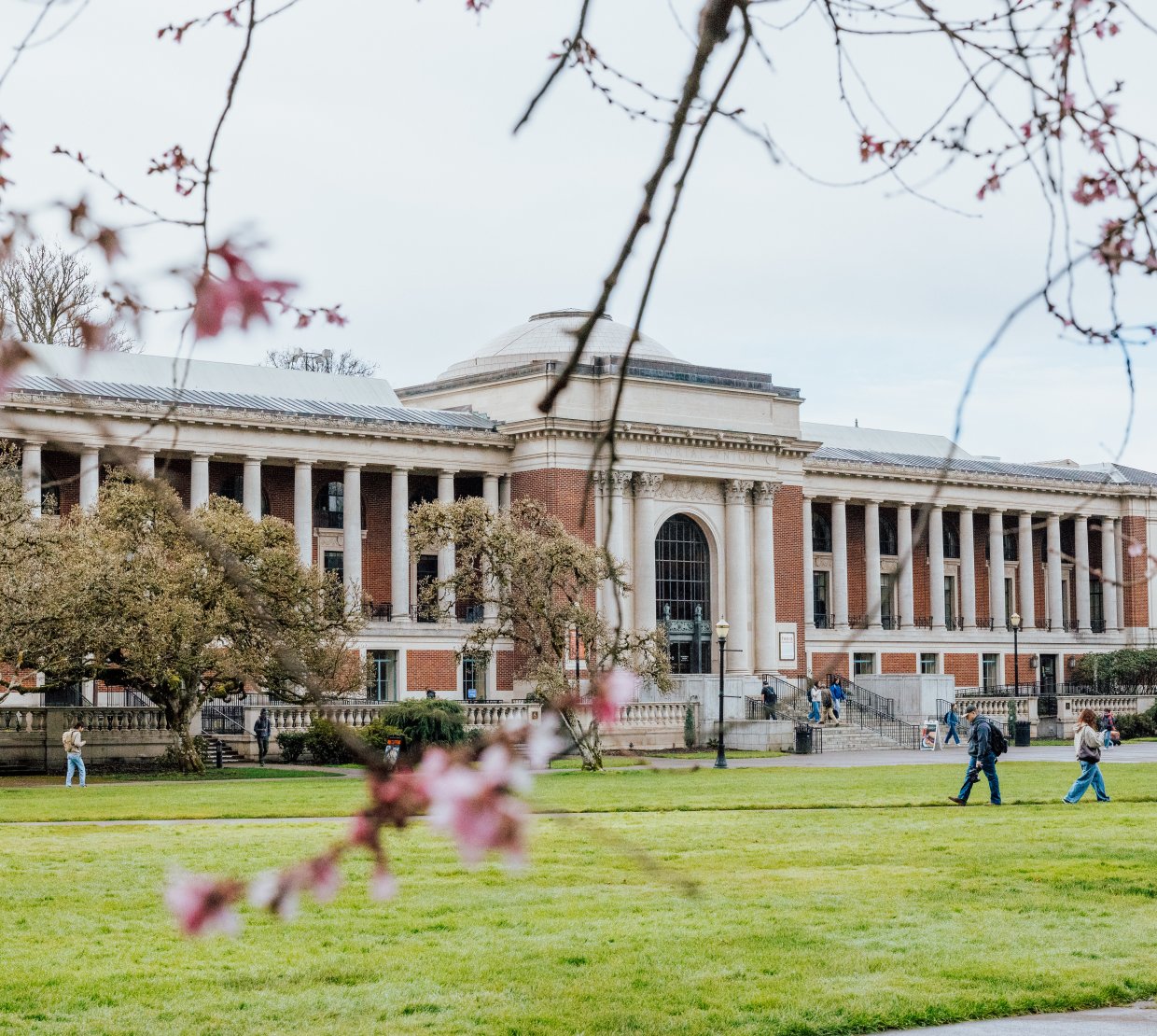
A general shot of memorial union on OSU campus with flowers.

The Wei family science legacy continues at Oregon State

By College of Science

The Wei Family Private Foundation supports Oregon State students working on complex problems across disciplines — from tracking PFAS in urban environments and studying Alzheimer’s disease at the molecular level to modeling vaccine protection and developing new battery materials — advancing work that addresses global challenges in health, the environment and energy.

Established to honor Dr. Chung Kwai Lui, the first woman to earn a Ph.D. from Oregon State, the Wei Scholarship reflects a lasting investment in scientific discovery and the students who drive it forward.

In February, the College of Science brought that work into focus, hosting the Board of Trustees of the Wei Family Private Foundation for a student research showcase. The event brought together undergraduate and graduate Wei Scholars to share their work and connect directly with the foundation whose support helps make it possible.

Representing the foundation were Edward Chen, Janet Chen, Dee Chen and John Donnelly.

“This scholarship carries forward a remarkable legacy, and we deeply appreciate how that legacy is expressed through personal connection,” said Dean Eleanor Feingold. “The trustees take a genuine interest in the scholars, which helps them feel known and supported. That came through clearly at the showcase.”

The foundation was welcomed by Dean Feingold, Executive Associate Dean Vrushali Bokil and Oregon State University Foundation partners. The College’s Research Development Unit played a key role in organizing the showcase.

People talk in a conference room.

Wei Family Private Foundation Board of Trustee Member, Edward Chen (center), engaged in conversation during the luncheon, as is fellow Board Member Janet Chen (back right).

Research across disciplines

At the showcase, Wei Scholars presented their research across chemistry, mathematics, microbiology and statistics, with projects examining disease at the molecular level and modeling health and environmental systems at scale.

Presentations included:

  • Paint: A potential source of PFAS in air and urban runoff
    Mitchell Kim-Fu, chemistry, fifth-year Ph.D.
  • A clustering method for functional data
    Xinyu “Erica” Li, statistics, second-year Ph.D.
  • Investigating lipid alterations in Alzheimer’s disease using MALDI mass spectrometry imaging
    Phoebe Lee, chemistry and mathematics, fourth-year B.S.
  • How well can we identify spatial patterns in gene expression within cell types?
    Weiqi “Grace” Li, statistics, second-year M.S.
  • Exploring the myxozoan sensing and signaling mechanism
    Laila Brubaker, microbiology, fourth-year M.S.
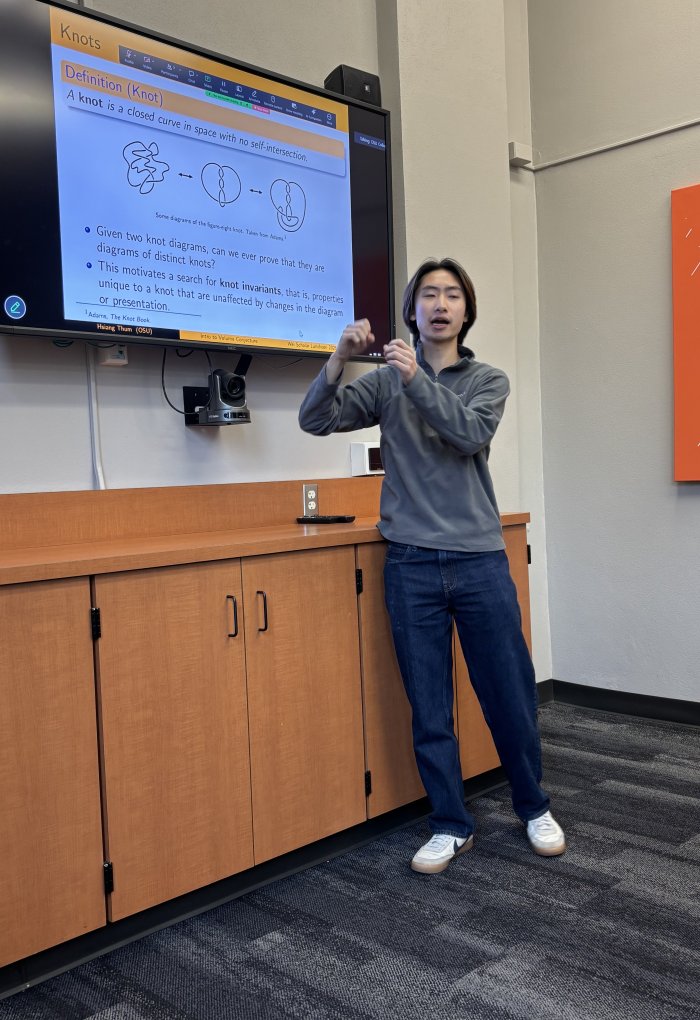
  • Introduction to the volume conjecture for knots
    Hsiang Thum, mathematics, fourth-year Ph.D.
  • An introduction to persistent homology transform
    Zejing Wang, mathematics, second-year Ph.D.
  • Measuring intrinsic vaccine protection across time and space
    Zhuoya “Joya” He, statistics, fourth-year Ph.D.
  • Glowing from invisible: Photon upconversion and its applications
    Mingcan Huang, chemistry, first-year Ph.D.
  • Making cheaper batteries by letting salts store energy
    Ziang Jiang, chemistry, second-year Ph.D.
  • Application of statistics in social science
    Jingtian Yu, chemistry, fifth-year Ph.D.

Additional Wei Scholars attended the showcase to support their peers, reflecting the strong sense of community within the program.

A man in sweat pants and a black sweatshirt stands at the front of a room near a computer screen.

Persistent homology transforms are explained by mathematics student Zejing Wang.

A community of scholars

For many students, the impact of the Wei Scholarship extends well beyond financial support.

“The Wei Scholarship has been instrumental in my graduate career by reducing financial stress and allowing me to focus on my academics,” said Mitchell Kim-Fu, a Ph.D. student in chemistry. “It has provided me with access to a network among the scholars and trustees. I’m impressed by the Wei Board of Trustee’s commitment to us because they foster a supportive and engaged relationship.”

Scholars also pointed to the relationships built through the program — with one another and with the foundation’s trustees.

“Their belief that we can contribute work that makes a meaningful impact on the world is especially inspiring,” said Ziang Jiang, a Ph.D. student in chemistry.

“I value the Wei Scholarship’s impact on my undergraduate career with gratitude and appreciation. This scholarship greatly supports my studies at OSU and inspires me to pursue graduate school. The Board made sure to connect with each of the scholars individually and showed interest in our research and academics,” said Phoebe Lee, a fourth-year student in a dual-degree bachelor’s program in mathematics and chemistry.

Others described the sense of connection and continuity that has developed around the program.

“The Wei Board has been nothing but kind to me and I sense that we are all immensely appreciative. I really like the annual dinner and appreciate them taking the time to come out to visit the scholars,” said Hsiang Thum, a fourth-year Ph.D. student in mathematics.

“It reminds me that there are people who truly believe in advancing science and supporting the next generation of researchers, and I feel very grateful and honored to be a Wei scholar. What stands out most to me is how genuine and caring the Trustees are. They travel from the East Coast each year to spend time with us, listen to our research and build personal connections that create a strong sense of support and belonging,” said Zhuoya He, a fourth-year Ph.D. student in statistics.

Hsiang Thum is a Mathematics student and here presents a theoretical discussion on the volume conjecture of knots.

Hsiang Thum, a mathematics student, presents a theoretical discussion on the volume conjecture of knots.