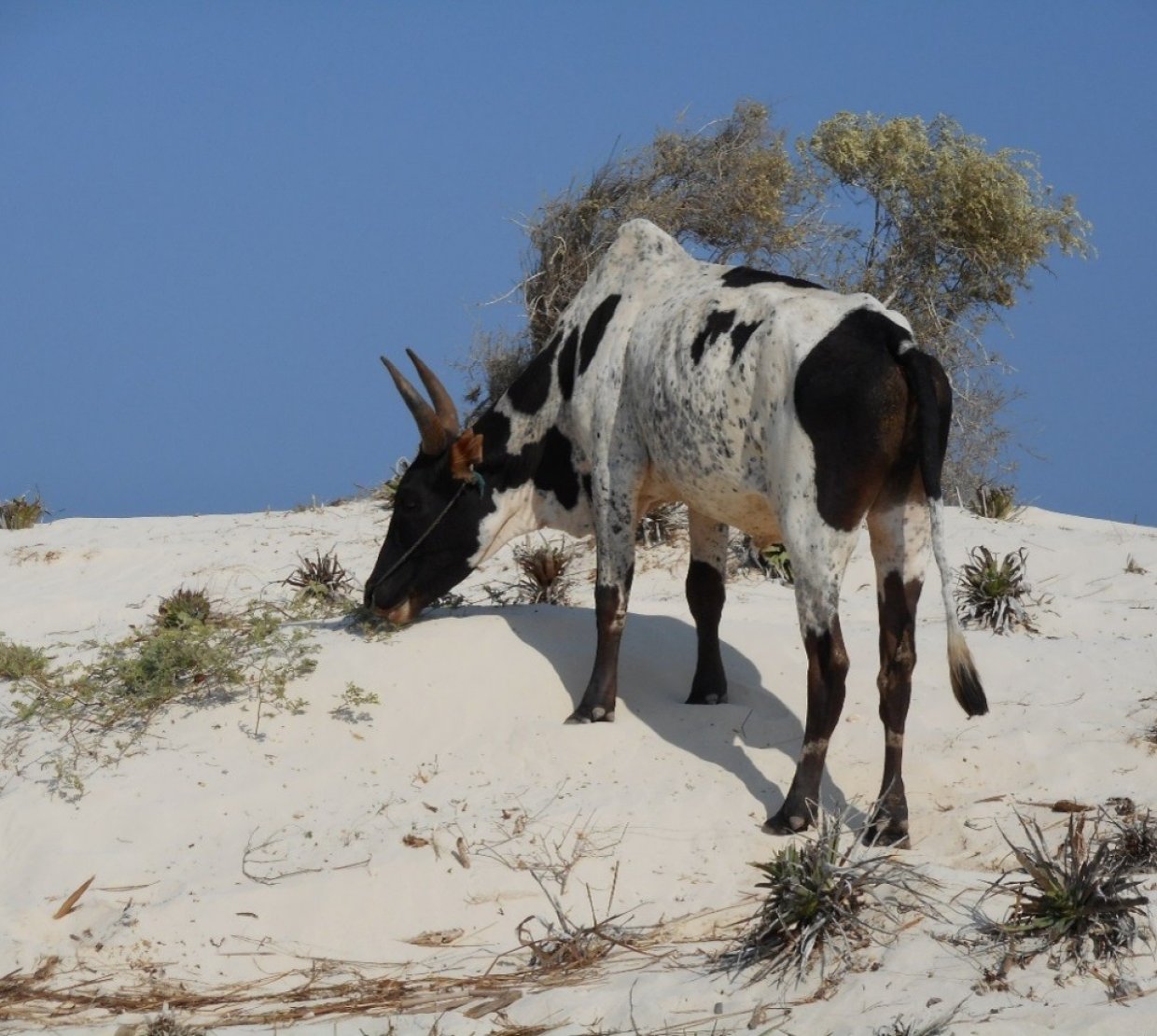
New analyses of ancient cattle, sheep and goat bones on Madagascar suggest the rapid spread of introduced livestock on the island 1,200 years ago coincided with forest loss and population declines of large native herbivores.
Madagascar provides a unique window into extinct ecosystems and the roles humans play in biodiversity loss, said study co-leader Sean Hixon, a postdoctoral researcher in associate professor Rebecca Terry’s integrative biology lab.
The findings, coupled with evidence of humans first appearing on Madagascar potentially thousands of years before introduced livestock did, suggest hunting alone did not drive the extinction of giant lemurs and other megafauna.
The study published in Proceedings of the Royal Society B adds to a treasure trove of scientific discovery fueled by the nation 250 miles off the east coast of Africa. As many as 90% of the species that live on Madagascar, which is roughly the size of Oregon and California put together, are found nowhere else as its plants and animals evolved independently from those on other continental land masses for about 88 million years.
“Over the past five years, we brought together the largest collection to date of ancient, introduced livestock bone samples from across Madagascar for radiocarbon and stable isotope analysis,” Hixon said. “The data confirm that livestock rapidly spread across the island about 1,200 years ago, approximately coinciding with the disappearance of animals like elephant birds and pygmy hippos.”
Hixon says sedimentary pollen-based vegetation reconstructions indicate that, within the last millennium, grasses likely became more abundant across much of the island. These types of reconstructions involve the analysis of fossil and sub-fossil pollen grains preserved in sediments to infer past plant communities at regional scales and beyond.
Meanwhile, paleoclimate reconstructions suggest that there was asynchronous drying on the island during recent millennia, which was previously thought to be a key driver of past large animal extinction.
Over the past 1,000 years, Madagascar’s cattle likely came to rely to a greater extent on C4 grasses – basically grasses whose photosynthesis process is well suited to warm and dry weather, as opposed to the C3 grasses that thrive in cooler and damper conditions.
“Although cattle might have preferred wet habitat, they successfully exploited relatively dry habitat during their earlier spread across the island,” Hixon said.
He added that the earliest documented presence of sheep and cattle in the island’s interior – more than a millennium ago – likely reflects a rapid spread of livestock across the island. The study reinforces the pattern that, regardless of asynchronous regional climate change, endemic large herbivores disappeared around the time that livestock, and predators such as dogs, were introduced, suggesting a causal link between livestock proliferation and past extinctions.


