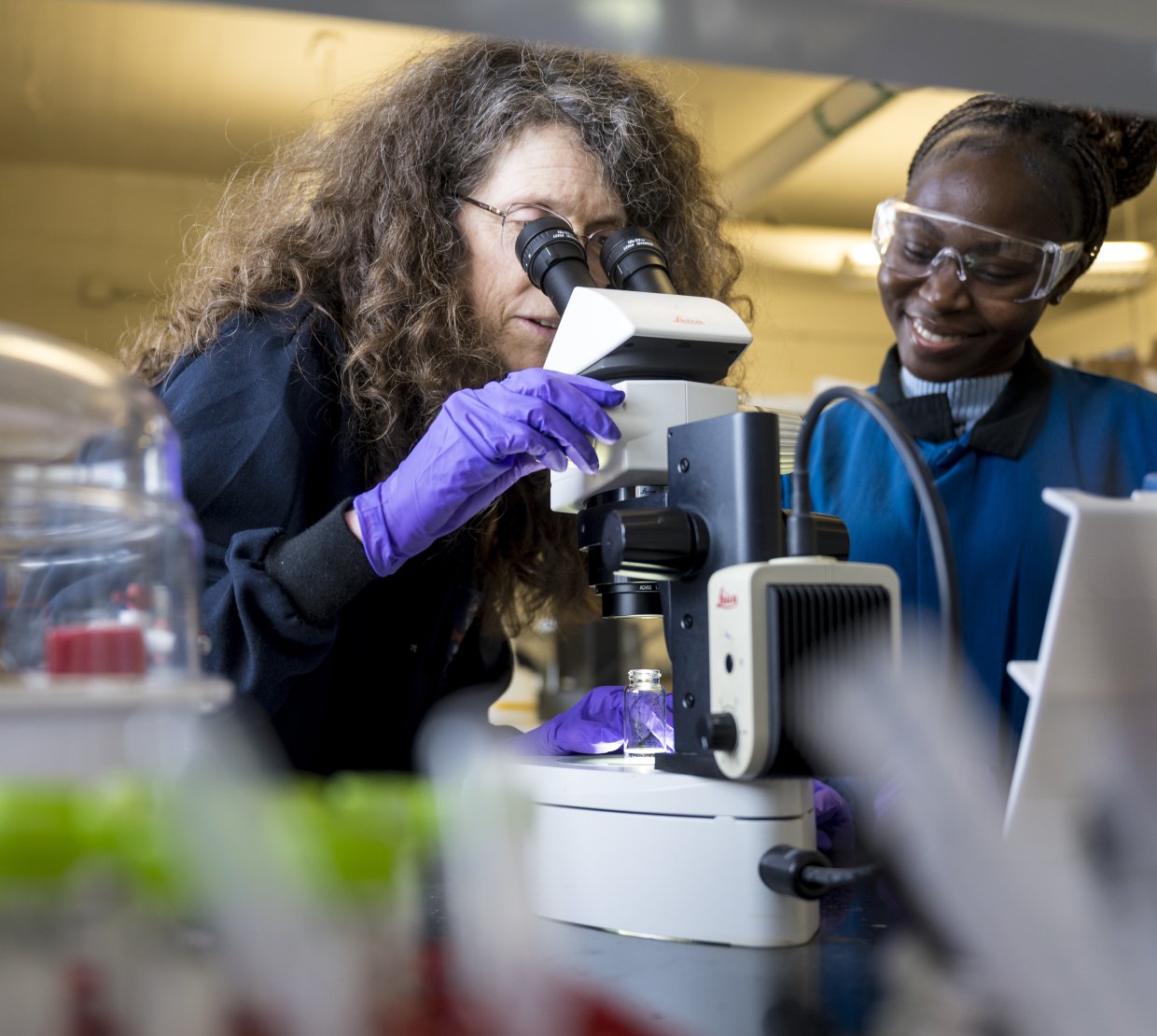
Originally from Nigeria, Julius studied industrial chemistry at Kaduna State University before moving to the U.S. to attend graduate school at Oregon State.
Her research explores how metal oxide clusters can function as lithography materials used in microchip manufacturing.
“Photolithography excites me because of the way it connects fundamental chemistry with real-world applications,” Julius said. “It amazes me how the molecules we synthesize in the lab can ultimately be used as lithography materials, which are essential for microchip production.”
For Julius, this research illustrates how chemistry shapes the devices people rely on every day.
“Cellphones rely on tiny molecules and materials that work together to make the whole system work efficiently and smartly,” she said.
One of the project's goals is to make the molecules used in lithography easier to produce.
Traditional synthesis methods can require complex procedures involving specialized equipment and high temperatures. Julius has been able to simplify the process dramatically.
“Instead of boiling it and using a special apparatus, she mixes things in a 10-milliliter beaker, and it takes 20 minutes at room temperature,” Nyman said.
Simplifying the chemistry could make the materials easier and cheaper to manufacture if they are eventually used in semiconductor production.
“We have to rely on chemistry to do its thing.”
Working at molecular scales presents enormous scientific challenges.
“As humans, we like to control everything,” Nyman said. “As chemists, we want to control molecules.”
But chemists cannot directly manipulate individual atoms with their hands.
“We don’t have little tweezers where we can go in and say, ‘OK, I’m going to break this bond and make that bond,’” she said. “We have to rely on chemistry to do its thing.”
Small imperfections can have major consequences for semiconductor devices. Even if 98% of the molecules behave as intended, the ones that don’t create defects that are compounded into defective microelectronic circuits, Nyman said.
Designing molecules that behave reliably, even under changing environmental conditions, is a major goal for Nyman and Julius.
The pair approaches the problem from a foundation of basic chemistry.
“We’ve always been a fundamental chemistry-first lab. Understanding how molecules interact, how they behave in solution and how we can manipulate them,” Nyman said.
Applications come later. While many other researchers try to start the other way around, her lab takes a different approach.
“I call it swimming with molecules,” she said. “Picture yourself swimming among them. What are they doing?”