In a busy, sun-lit row lined with research posters, presenters and attendees, a young man in a button-up shirt discusses his poster with two others.

BioHealth Sciences student investigates addiction science at OHSU internship

By Elana Roldan

Qiying Ma was at the intersection of crisis and community. As a volunteer for the Chinese Friendship Association of Portland in January 2022, he navigated the aisles of a community vaccine clinic, acting as a vital link for local community members who did not speak English. Amidst the rush of the pandemic, he gained a spark for a career in healthcare.

“Witnessing how pharmacists provided culturally sensitive care during that particular time inspired me,” he said. “That propelled me forward on this track.”

Now a senior BioHealth Sciences major at Oregon State University, Ma’s journey has evolved from the front lines of community volunteering to bioinformatic research. At the center of that transformation is a prestigious, eight-week internship at Oregon Health & Science University through the OHSU Equity Research Program.

While his roots are in direct patient care, his time at Oregon State revealed a fascination with the molecular mechanics behind medicine. The strong foundation he built in undergraduate research at OSU bridged into the OHSU internship, where he learned to apply his skillset to the complex, exciting world of bioinformatics. After graduating at the end of this term, Ma will continue expanding his toolkit as he dives into pharmacy school in the fall.

Disentangling the data

Ma’s undergraduate research career began at the BEAVERS Lab, which conducts psychophysiological research on stress responses in relation to addiction. His work there focused on human subjects and used electromyography to assess stress responses when paired with alcohol.

“The research experiences at OSU pave a strong foundation for you to conduct research anywhere else,” he said. Now a seasoned member of the BEAVERS Lab, he has moved from student to teacher, mentoring new students with protocols and running experiments. Ma currently assists the lab in investigating how concussions affect stress response levels.

This combination of technical proficiency and leadership provided the ideal launchpad for Ma. By mastering protocols and learning the nuances of data collection, he developed the scientific grit needed to secure a prestigious summer role at one of the region’s top research institutions.
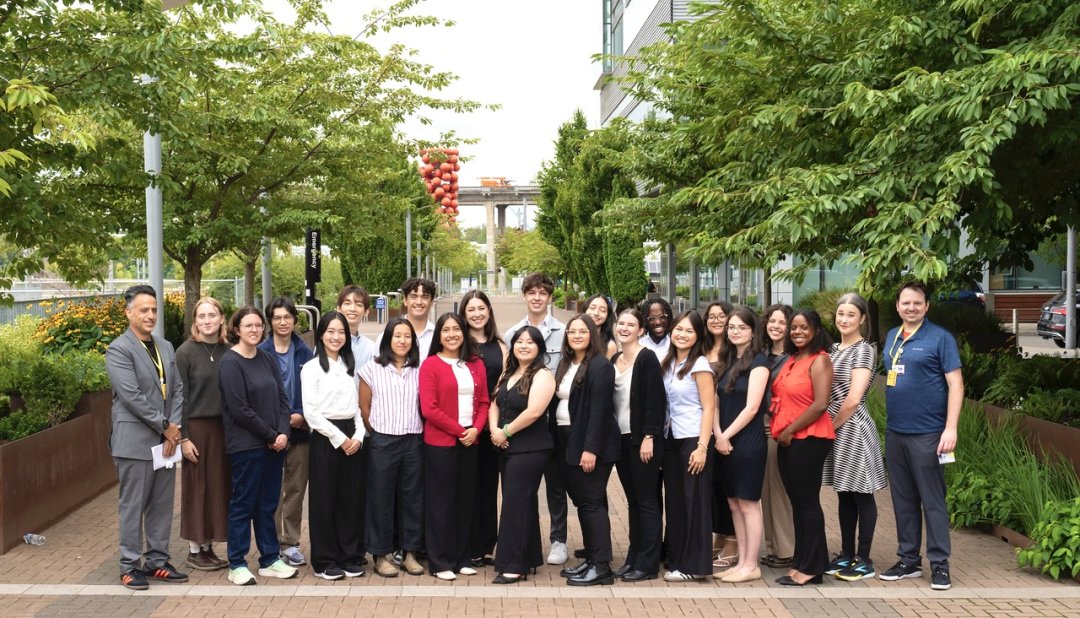
On a sunny day, a large group of people in business-casual attire stand and smile at the camera on a brick campus road lined with trees.

At his internship, Ma joined a cohort of 22 undergraduates from many backgrounds to conduct intensive research over the summer.

As he searched for potential research opportunities for the summer of his third year at Oregon State, Ma stumbled upon the OHSU Equity Internship Program. It quickly stood out as an outstanding opportunity: full-time research, free housing, workshops and networking with program alumni, and mentoring from healthcare professionals. Armed with the skills he learned in the BEAVERS Lab, he was thrilled to be accepted into the program.

Ma spent eight weeks at the Oregon National Primate Research Center, located in OHSU’s West Campus, working within the Bioinformatics and Biostatistics Core (BBC). Under the mentorship of Director Suzanne Fei, Ma pushed his boundaries into the world of big data.The internship focused on a critical question in addiction science: are drinking behaviors more influenced by the biological factors in the blood or the brain tissue itself? To investigate this, he analyzed RNA sequences from the monkey rhesus macaques and compared the data of distinct pre- and post-perfusion treatment groups.

“Perfusion is basically the removal of blood. So for pre-perfusion, blood is still circulating throughout the brain. But for post-perfusion, we remove the blood and instead use a different solution that mimics the components of the blood, keeping the brain cells alive,” he explained.

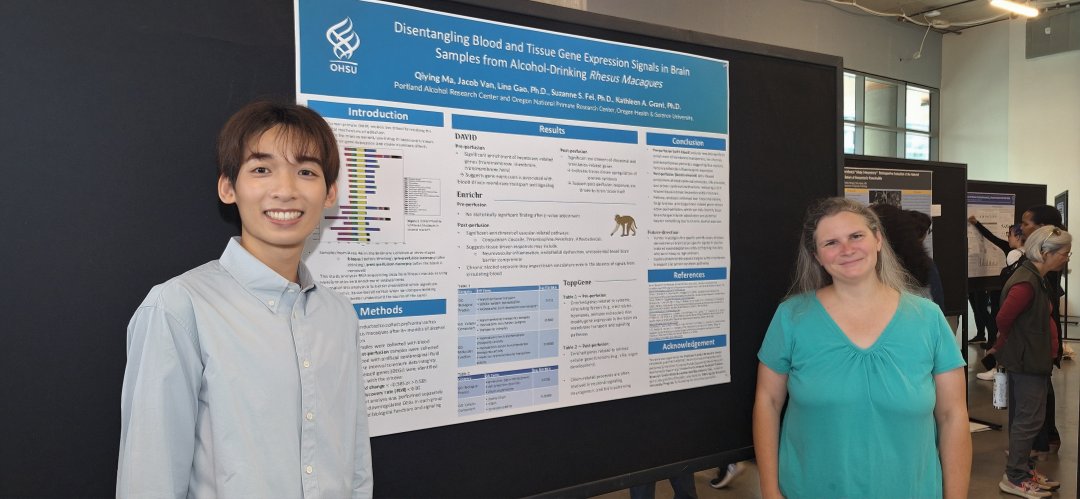
A man and a woman stand at both ends of a research poster, smiling at the camera. The man is in a button-up shirt and the woman is wearing a turquoise blouse.

Alongside research and networking opportunities, the OHSU program emphasized mentorship. Ma worked with Suzanne Fei, director of the Oregon National Primate Research Center’s Bioinformatics & Biostatistics Core.

This allowed the team to disentangle whether alcohol-associated gene expressions were coming from the blood or the brain tissue. Using a pathway enrichment analysis, a sophisticated computational tool, Ma identified notable differences between the two groups.

In the pre-perfusion group, where blood was still present, the data showed a significant enrichment of genes related to detoxification. In contrast, the post-perfusion group showed genes more heavily involved in developmental processes. His research concluded that blood-related factors play a stronger role than brain tissue in shaping drinking-associated changes in gene expression. This suggests separating blood-derived and tissue-derived signals is critical to understanding how alcohol impacts the brain.

The technical nature of the work was initially daunting. Coming into a bioinformatics role often feels like learning a new language, but Ma found that his background in BioHealth Sciences allowed him to bridge the gap between biological theory and computational output. The experience also highlighted for him the importance of persistence and following where your fascinations lead you.

“You don’t have to be good at everything. Just focus on what you are really interested in — that really helps you concentrate and produce something meaningful,” he said.

A strong foundation for a strong future

While the internship was a masterclass in data science, it also offered a broader professional roadmap. The networking workshops Ma attended helped him forge connections that showed how his interest in bioinformatics could complement his future career as a pharmacist.

“It provided an opportunity to get valuable insights into bioinformatics research and to explore the field as a future career option,” he reflected. “I gained invaluable mentorship and connections that I don’t think I would’ve otherwise.”

Ma’s journey has consistently widened in scope as he progressed, building from the vaccine clinic to his foundational undergraduate research to the summer internship. Yet, his core motivation remains rooted in the community he served during the pandemic. He views science not as an isolated academic pursuit, but as a tool for advocacy and better patient outcomes.

With pharmacy school acceptances already secured, he is ready for his next transition. His advice for prospective students is a testament to the mindset that carried him through eight weeks of intense analysis and four years of rigorous coursework: stay curious, and stay resilient.

“Always seek out opportunities and don’t hesitate to apply to those that align with your interests,” he said. As he looks toward the future, he carries the lessons and expertise he’s gained as a beav with him. “Trust the process, and you will end up where you’re meant to be.”

Applications to the OHSU Equity Research Program were open last year from Nov. 12, 2025 to Jan. 23, 2026.