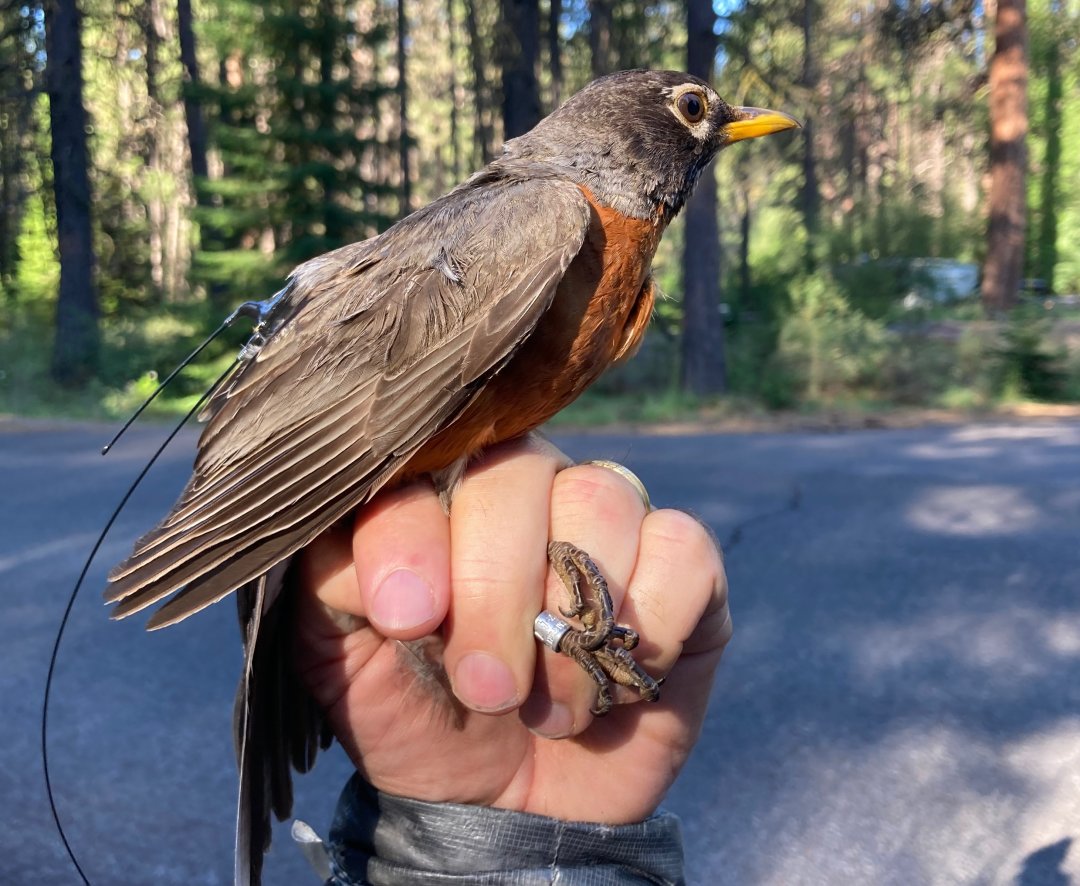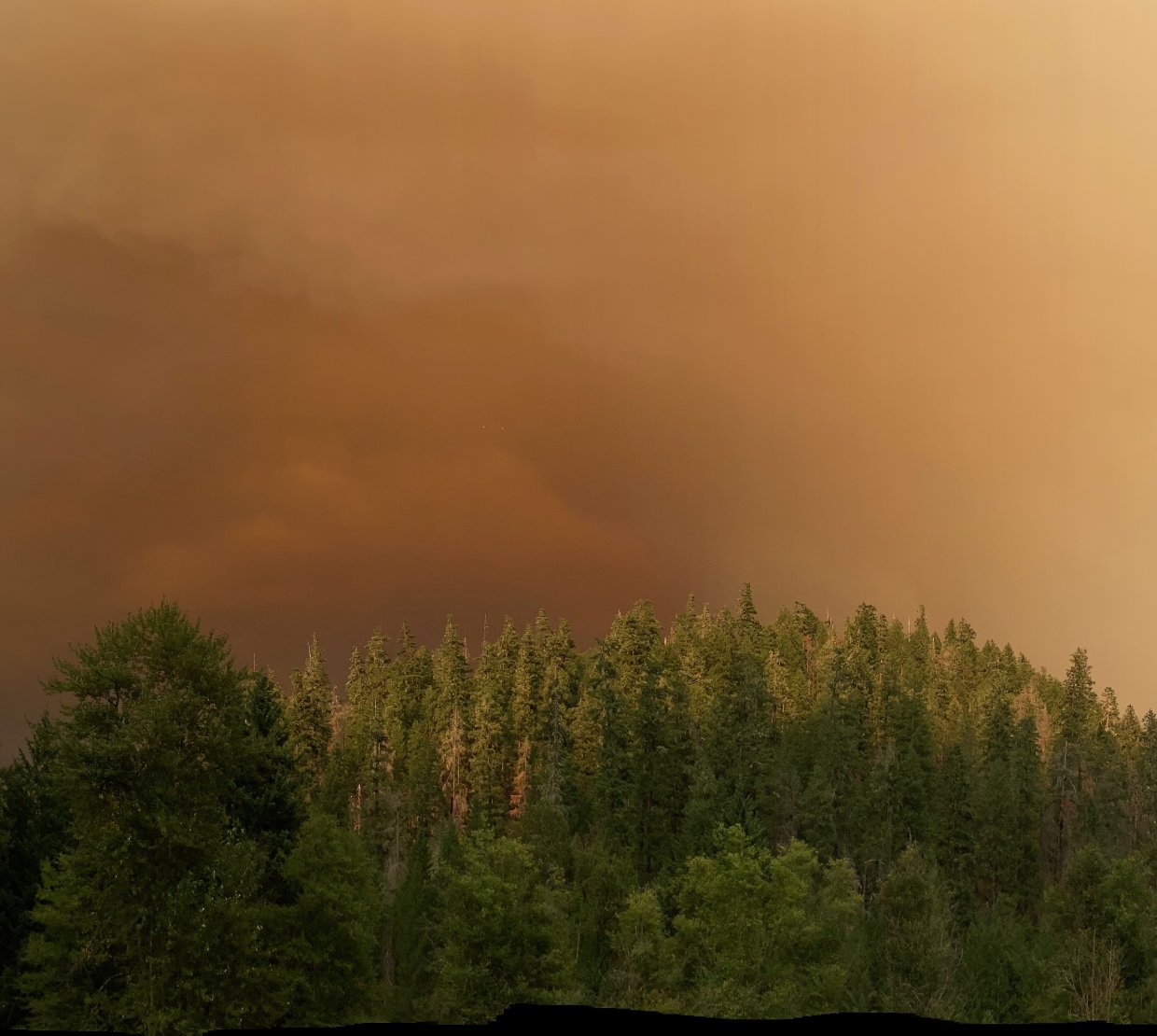
Research by College of Science biologists suggests that toxic air stemming from wildfires won’t necessarily prompt animals to flee in search of better breathing conditions.
The study of American robins led by Jamie Cornelius is one of the few to examine how wildfire smoke, an increasingly common phenomenon as annual fire seasons become longer and more intense, affects animal behavior.
Published in Integrative and Comparative Biology, the paper also presents a “stay, shift, go” framework for characterizing how wildlife species respond to smoky conditions.
“Wildfire smoke is an increasing disturbance across much of the globe yet it hasn’t received much attention as a driver of animal behavior,” Cornelius said. “Animals may have evolved strategies to cope with smoke exposure, but what those strategies are and how they affect health outcomes are largely unknown.”
Cornelius and collaborators at UCLA and Cornell University found, somewhat surprisingly, that the birds in their study didn’t simply fly away as foul air set in.
“Robins in the post-breeding season, despite not being tied to a nest location, did not just leave when it got smoky,” said Cornelius, an ecophysiologist in the Department of Integrative Biology. “Instead they shifted behavior to reduce activity, presumably to limit the negative consequences of smoke inhalation, and oriented differently according to prevailing wind conditions.”
To learn what the birds were doing, the scientists captured 21 adult robins in fire-prone habitat in Oregon, affixed them with data-transmitting bands and monitored their movements during the 2023 and 2024 wildfire seasons.
The researchers hypothesized that the robins would follow a “go” strategy to avoid smoke from nearby wildfires. What they found, though, was that the birds made shorter-distance movements as wildfire smoke intensity grew.
They also learned that robins didn’t change their orientation behavior relative to wind direction under light smoke, but they were more likely to orient into the wind in the presence of heavy smoke, which tended to reduce their smoke exposure.
“It’s possible that robins do attempt to flee high-density smoke with long-distance movements and that the levels of smoke that occurred during our study were not quite high enough to induce that response,” Cornelius said. “There could be some threshold that triggers the ‘go’ response that was not reached.”
Often detectable by sight and/or smell, wildfire smoke is a complex mixture of gases and particulate matter that can be harmful to people and animals when inhaled or ingested. With large fires, Cornelius notes, potentially billions of organisms are exposed to toxic air as the smallest particles remain airborne indefinitely and can travel for hundreds or thousands of miles.